Present perfect
Angleščina · 9. razred
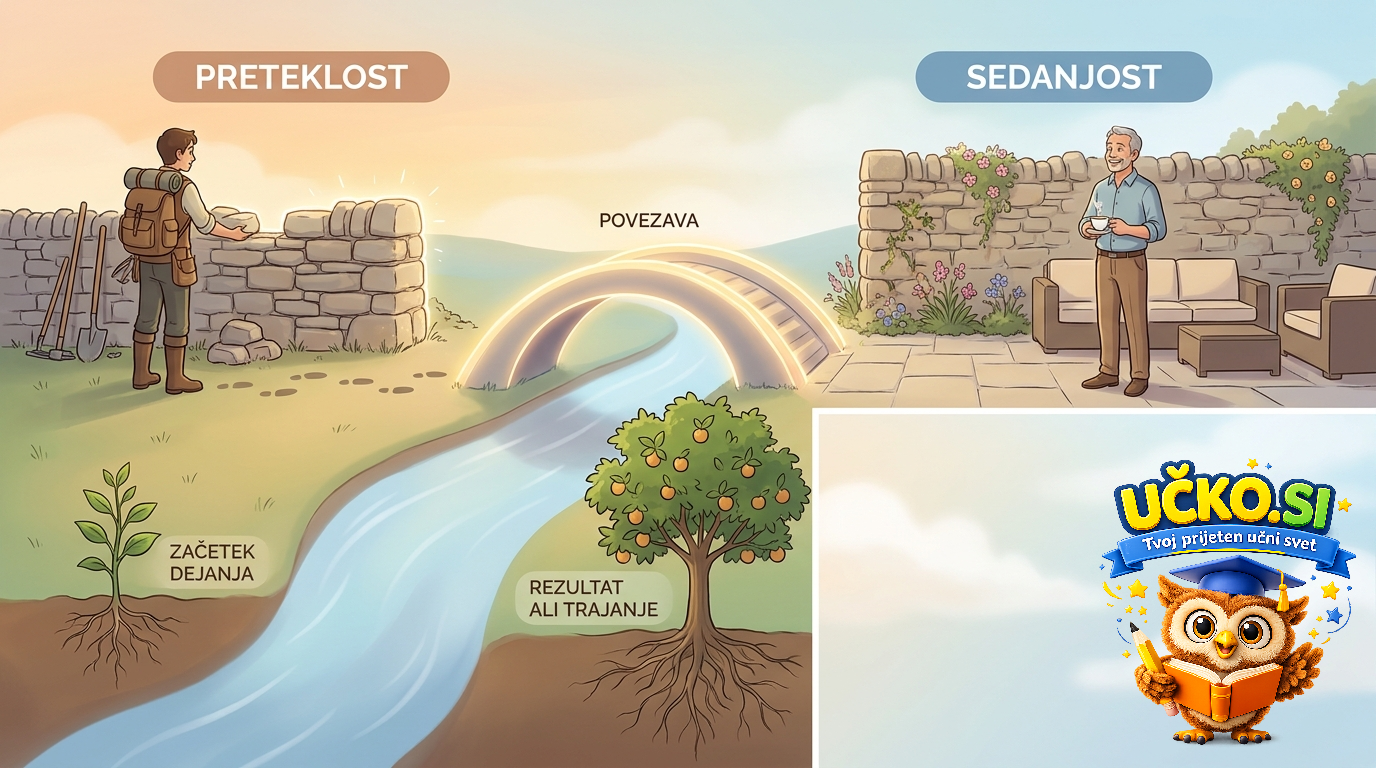
The Present Perfect tense connects the past with the present, describing actions that happened at an unspecified past time or started in the past and continue now. It might seem new as Slovenian doesn't have an exact match, but it's very useful for talking about experiences and current results.
Ključni pojmi
- Present Perfect
- A verb tense connecting past actions to the present.
- Past Participle
- The third form of a verb, used in the Present Perfect.
- For
- Used with Present Perfect to show duration.
- Since
- Used with Present Perfect to show a starting point.
- Irregular Verbs
- Verbs with unique past participle forms that need to be learned.
When to Use the Present Perfect
We use the Present Perfect for experiences in your life without a specific time, like 'I have visited London.' It also describes actions that began in the past and are still ongoing, often with 'for' (duration) or 'since' (starting point). Additionally, it's used for recently finished actions that have a clear result in the present, for example, 'I have lost my keys' means you don't have them now.
- Used for experiences without a specific time.
- Used for actions started in the past and continuing now.
- Used for recent actions with a present result.
How to Form the Present Perfect
To form the Present Perfect, you need 'subject + have/has + past participle.' 'Have' is used with I, you, we, they, and 'has' with he, she, it. For regular verbs, the past participle is the same as the past simple (verb + -ed), but irregular verbs have unique forms that you need to learn.
- Structure: subject + have/has + past participle.
- Use 'have' for I, you, we, they; 'has' for he, she, it.
- Regular verbs: verb + -ed; Irregular verbs: learn specific forms.
Making Sentences and Questions
For positive sentences, follow the structure: 'I have played football.' For negative sentences, add 'not' after 'have/has' (e.g., 'She hasn't seen that movie'). To ask questions, start with 'Have/Has' before the subject (e.g., 'Have you ever visited London?'). Short answers are 'Yes, I have' or 'No, I haven't.'
- Positive: Subject + have/has + past participle.
- Negative: Subject + have/has + not + past participle (haven't/hasn't).
- Questions: Have/Has + subject + past participle?
Zanimivosti
- The Present Perfect connects the past with the present.
- 'For' tells us the duration, while 'since' tells us the starting point.
- Keywords like 'just', 'yet', and 'already' are often used with the Present Perfect.
Povzetek
The Present Perfect tense describes actions linked to the present, such as experiences, ongoing situations, or actions with current results. It's formed with 'have/has' and the past participle, and is used with keywords like 'for', 'since', 'just', 'yet', and 'already'. Mastering this tense helps you talk about how past events relate to now.
Pogosta vprašanja
Kaj se naučimo pri temi Present perfect?
The Present Perfect tense connects the past with the present, describing actions that happened at an unspecified past time or started in the past and continue now. It might seem new as Slovenian doesn't have an exact match, but it's very useful for talking about experiences and current results.
Kaj je present perfect?
A verb tense connecting past actions to the present.
Kaj je past participle?
The third form of a verb, used in the Present Perfect.
Kaj je for?
Used with Present Perfect to show duration.
Kako na kratko povzamemo temo Present perfect?
The Present Perfect tense describes actions linked to the present, such as experiences, ongoing situations, or actions with current results. It's formed with 'have/has' and the past participle, and is used with keywords like 'for', 'since', 'just', 'yet', and 'already'. Mastering this tense helps you talk about how past events relate to now.
Sorodne razlage – Angleščina, 9. razred
- Present perfect and past simple
- Present perfect with for and since
- Present simple
- Present simple and present continuous
- Present tenses
- Present tenses with future meaning
- Pronunciation and fluency
- Quantifiers and determiners
- Quantifiers: too, too much/many, (not) enough, a/an, some/any, much/many, a few, a lot of
- Question tags
- Questions and question forms
- Reacting to news