Quantifiers: too, too much/many, (not) enough, a/an, some/any, much/many, a few, a lot of
Angleščina · 9. razred
Quantifiers are words that tell us about the amount or quantity of something. They are very important for speaking and writing English correctly. Let's learn how to use them!
Ključni pojmi
- Quantifiers
- Words that tell about amount or quantity.
- Countable nouns
- Nouns you can count individually (e.g., apples).
- Uncountable nouns
- Nouns you cannot count individually (e.g., water).
- Indefinite articles
- A and AN, meaning 'one of something'.
Too, Enough, and Not Enough
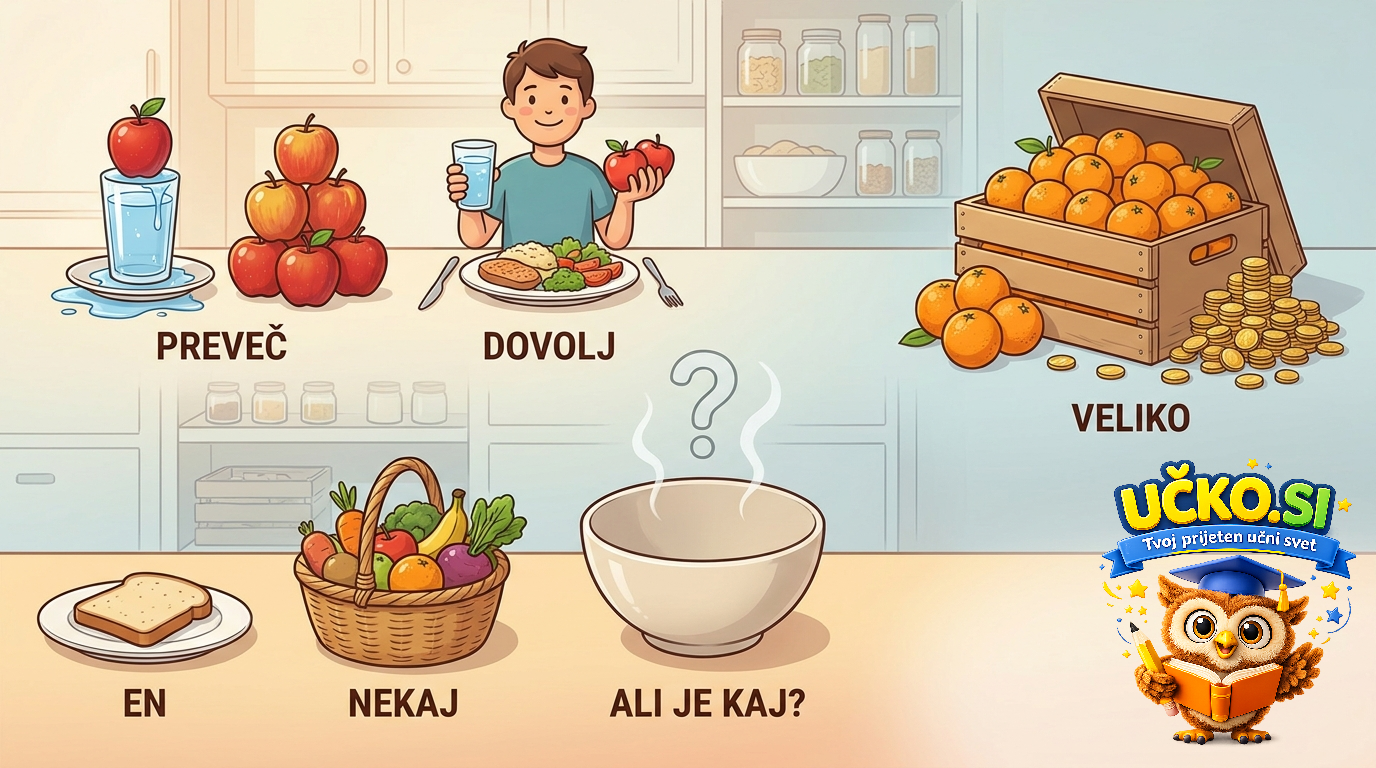
TOO means 'more than necessary or desired'. ENOUGH means 'sufficient' or 'as much as needed', while NOT ENOUGH means 'less than necessary or desired'. We use 'too' with adjectives, and 'enough' can follow adjectives or precede nouns.
- Too: more than necessary (too hot)
- Enough: sufficient (enough money)
- Not Enough: less than necessary (not enough milk)
Too Much/Many and A/An
TOO MUCH is used with uncountable nouns like 'sugar' or 'homework'. TOO MANY is used with countable nouns such as 'people' or 'apples'. A and AN are indefinite articles meaning 'one of something', used before words starting with consonant and vowel sounds respectively.
- Too Much: for uncountable nouns (too much sugar)
- Too Many: for countable nouns (too many people)
- A/An: for single, non-specific items (a book, an apple)
Some, Any, Much, Many
SOME is used in positive sentences with both countable and uncountable nouns, and for offers. ANY is for negative sentences and questions. MUCH is used with uncountable nouns, usually in questions and negatives, meaning 'a large amount'. MANY is used with countable nouns, meaning 'a large number', also mostly in questions and negatives.
- Some: positive sentences, offers (some friends, some water)
- Any: negative sentences, questions (don't have any money, any questions)
- Much: large amount (uncountable, e.g., much time)
- Many: large number (countable, e.g., many books)
A Few, A Little, A Lot Of
A FEW is used with countable nouns to mean 'a small number'. A LITTLE is used with uncountable nouns to mean 'a small amount'. A LOT OF / LOTS OF are informal and can be used with both countable and uncountable nouns in all sentence types to mean 'a large quantity or number'.
- A Few: small number (countable, e.g., a few friends)
- A Little: small amount (uncountable, e.g., a little sugar)
- A Lot Of/Lots Of: large quantity/number (both countable and uncountable)
Zanimivosti
- The word 'hour' uses 'an' because the 'h' is silent.
- SOME can be used in questions when you offer something or expect a 'yes' answer.
- A LOT OF and LOTS OF are informal ways to say 'a large quantity or number'.
Povzetek
Quantifiers help us describe amounts and quantities. We learned about using 'too' and '(not) enough', 'too much/many', 'a/an', 'some/any', 'much/many', and 'a few/a little/a lot of'. Practicing these will make your English more precise!
Pogosta vprašanja
Kaj se naučimo pri temi Quantifiers: too, too much/many, (not) enough, a/an, some/any, much/many, a few, a lot of?
Quantifiers are words that tell us about the amount or quantity of something. They are very important for speaking and writing English correctly. Let's learn how to use them!
Kaj je quantifiers?
Words that tell about amount or quantity.
Kaj je countable nouns?
Nouns you can count individually (e.g., apples).
Kaj je uncountable nouns?
Nouns you cannot count individually (e.g., water).
Kako na kratko povzamemo temo Quantifiers: too, too much/many, (not) enough, a/an, some/any, much/many, a few, a lot of?
Quantifiers help us describe amounts and quantities. We learned about using 'too' and '(not) enough', 'too much/many', 'a/an', 'some/any', 'much/many', and 'a few/a little/a lot of'. Practicing these will make your English more precise!
Sorodne razlage – Angleščina, 9. razred
- Question tags
- Questions and question forms
- Reacting to news
- Reading for gist/skimming
- Reading strategies
- Recognising contractions
- Recognising informal speech
- Relative clauses
- Relative pronouns
- Remembering what you hear
- Reported offers, requests, suggestions and commands
- Reported speech