Reported speech
Angleščina · 9. razred
Reported speech is when we tell someone what another person said without using their exact words. It's like telling a story about a conversation. We often use it to share information from others.
Ključni pojmi
- Reported Speech
- Telling what another person said without using their exact words.
- Direct Speech
- Using the exact words of the speaker, usually in quotation marks.
- Backshift
- Verb tenses moving one step back into the past in reported speech.
- Reporting Verb
- A verb (like 'said' or 'told') used to introduce reported speech.
Direct vs. Reported Speech
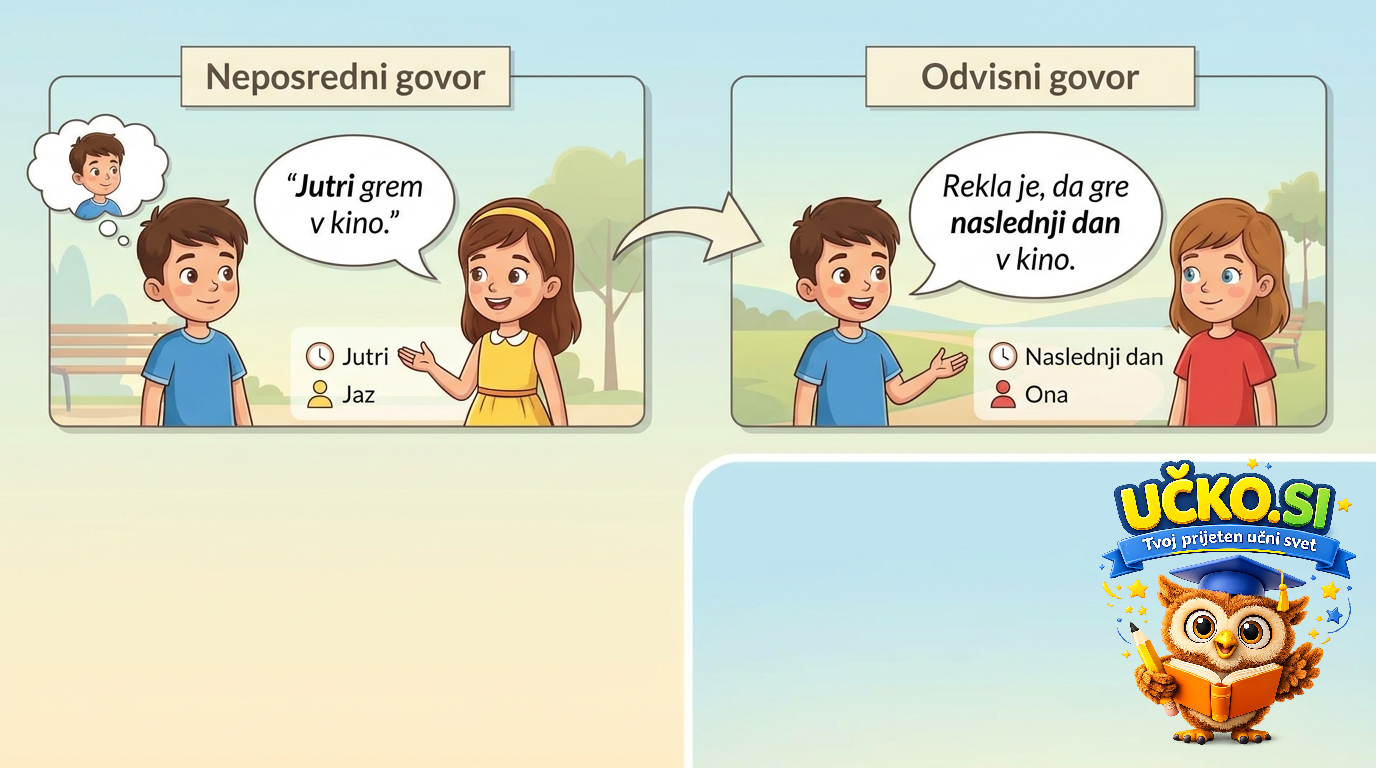
Direct speech uses the exact words of a speaker, usually inside quotation marks. Reported speech tells you what was said without the exact words, often using a reporting verb like 'said' or 'told'. We can sometimes use 'that' after the reporting verb. For example, 'She said, "I am happy."' becomes 'She said that she was happy.'
- Direct speech uses exact words and quotation marks.
- Reported speech describes what was said, often with 'said' or 'told'.
Key Changes in Reported Speech
When changing to reported speech, we usually make three main changes: tenses, pronouns, and time/place expressions. Tenses often 'backshift' one step into the past when the reporting verb is in the past. Pronouns change to reflect who is speaking and who is being spoken about. Time and place words also change to fit the new context.
- Tenses usually move one step back (backshift).
- Pronouns change based on the speaker.
- Time and place expressions adapt to the new reporting moment.
Reporting Questions and Verbs
When reporting questions, we remove question marks and change the word order to a statement form. For yes/no questions, we use 'if' or 'whether'. For 'Wh-' questions, we keep the question word. The most common reporting verbs are 'say' (when no listener is mentioned) and 'tell' (when you mention who was spoken to).
- Reported questions don't use question marks and have statement word order.
- 'Say' is used without a listener, 'tell' is used when a listener is mentioned.
Zanimivosti
- The word 'that' can sometimes be left out in reported speech.
- Modals like 'could', 'would', 'might', 'should', and 'ought to' usually don't change in reported speech.
- When reporting questions, the sentence structure changes from a question to a statement.
Povzetek
Reported speech lets us share what someone said without using their exact words. It involves changing tenses, pronouns, and time/place expressions, especially when the reporting verb is in the past. We use 'say' or 'tell' and follow specific rules for statements and questions.
Pogosta vprašanja
Kaj se naučimo pri temi Reported speech?
Reported speech is when we tell someone what another person said without using their exact words. It's like telling a story about a conversation. We often use it to share information from others.
Kaj je reported speech?
Telling what another person said without using their exact words.
Kaj je direct speech?
Using the exact words of the speaker, usually in quotation marks.
Kaj je backshift?
Verb tenses moving one step back into the past in reported speech.
Kako na kratko povzamemo temo Reported speech?
Reported speech lets us share what someone said without using their exact words. It involves changing tenses, pronouns, and time/place expressions, especially when the reporting verb is in the past. We use 'say' or 'tell' and follow specific rules for statements and questions.
Sorodne razlage – Angleščina, 9. razred
- Scanning for specific information
- Second conditional
- Sentence stress
- Short /ɒ/ and long /ɔ:/
- Skills and abilities
- Some/any
- Speaking strategies
- Subject and object questions
- Superlative adjectives
- Syllables and word stress
- Talking about photos
- The passive: present and past