Second conditional
Angleščina · 9. razred
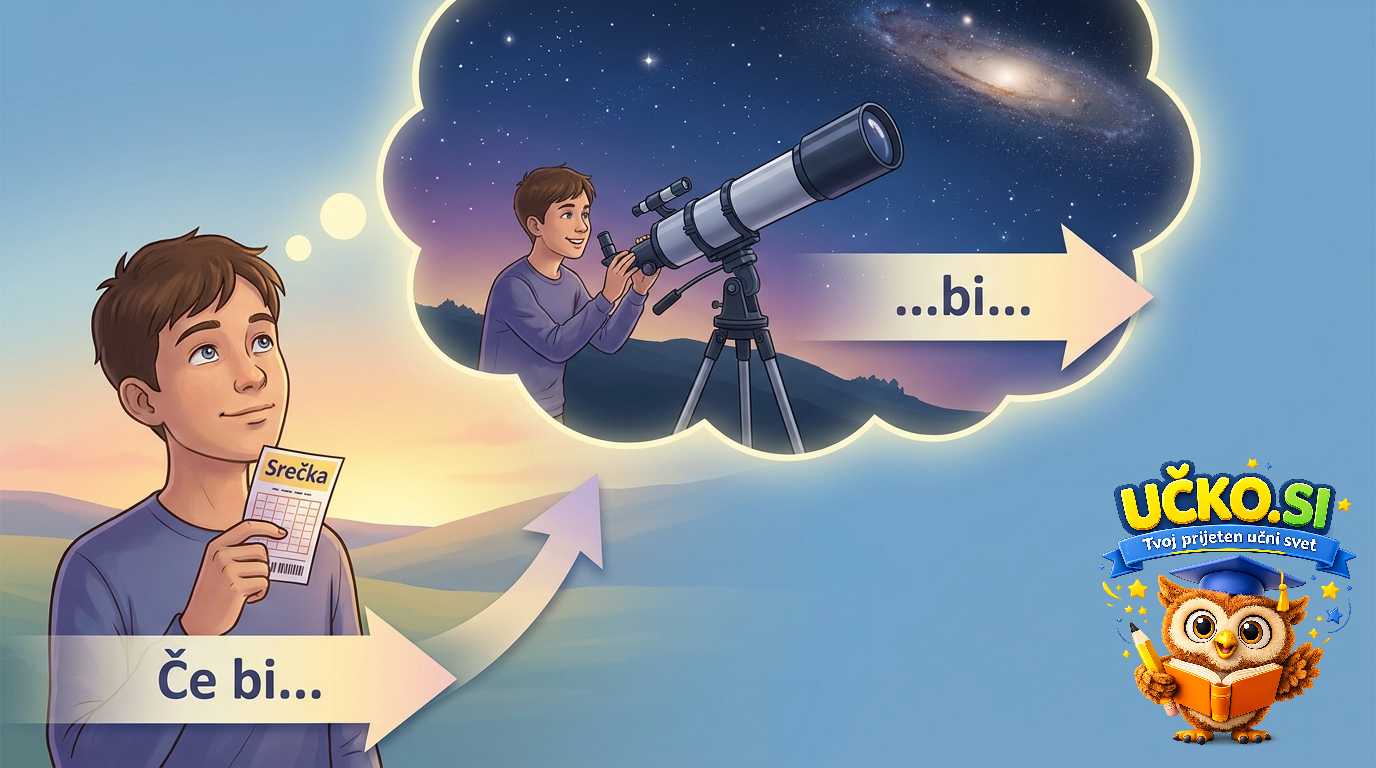
Welcome to the Second Conditional! We use it to talk about imaginary situations and their possible outcomes. It's perfect for expressing wishes, dreams, or giving advice about things that are unlikely to happen.
Ključni pojmi
- Hypothetical
- Based on an idea or suggestion rather than fact.
- Unlikely
- Not probable to happen.
- Imaginary
- Existing only in the imagination.
- Advice
- Guidance or recommendations.
What is the Second Conditional?
The Second Conditional helps us discuss things that are improbable in the present or future, or totally made-up situations. Think of it as a 'what if' for scenarios that probably won't come true. It describes an unreal condition and its imaginary result.
- Used for unlikely or imaginary situations.
- Talks about the present or future.
Building Second Conditional Sentences
A Second Conditional sentence has two parts: the 'if' clause and the main clause. The 'if' clause uses the past simple tense. The main clause uses 'would' followed by the base form of the verb. For the verb 'to be' in the 'if' clause, we often use 'were' for all subjects.
- Structure: If + past simple, would + base form.
- Use 'were' for 'to be' in the 'if' clause (e.g., If I were you...).
When to Use It
We use the Second Conditional for imaginary or hypothetical situations in the present or future, like 'If I were a superhero, I would fly to school.' It's also great for giving advice, often starting with 'If I were you...', and for polite requests or suggestions.
- For imaginary situations (e.g., If I won the lottery...).
- For giving advice (e.g., If I were you...).
- For polite requests or suggestions.
Zanimivosti
- Even though it talks about the present or future, the 'if' clause uses the past simple tense.
- You can reverse the order of the clauses; if the 'if' clause comes second, no comma is needed.
Povzetek
The Second Conditional describes imaginary or unlikely situations and their results. It uses 'if + past simple' and 'would + base verb'. It's useful for wishes, dreams, advice, and polite suggestions.
Pogosta vprašanja
Kaj se naučimo pri temi Second conditional?
Welcome to the Second Conditional! We use it to talk about imaginary situations and their possible outcomes. It's perfect for expressing wishes, dreams, or giving advice about things that are unlikely to happen.
Kaj je hypothetical?
Based on an idea or suggestion rather than fact.
Kaj je unlikely?
Not probable to happen.
Kaj je imaginary?
Existing only in the imagination.
Kako na kratko povzamemo temo Second conditional?
The Second Conditional describes imaginary or unlikely situations and their results. It uses 'if + past simple' and 'would + base verb'. It's useful for wishes, dreams, advice, and polite suggestions.
Sorodne razlage – Angleščina, 9. razred
- Sentence stress
- Short /ɒ/ and long /ɔ:/
- Skills and abilities
- Some/any
- Speaking strategies
- Subject and object questions
- Superlative adjectives
- Syllables and word stress
- Talking about photos
- The passive: present and past
- The passive: questions and answers
- Third conditional