The passive: questions and answers
Angleščina · 9. razred
Today, we'll learn how to ask and answer questions using the passive voice. Remember, the passive voice is important when the action is more significant than the person doing it, or when we don't know who did it. It's formed with 'to be' + the past participle.
Ključni pojmi
- Past participle
- Deležnik
- Active voice
- Aktiv
- Passive voice
- Pasiv
- Wh- word
- Vprašalnica
- Subject
- Osebek
Forming Yes/No Questions in Passive
To ask a Yes/No question in the passive voice, you start the sentence with the 'to be' verb. This verb comes before the subject of the sentence. For example, instead of 'Did they clean the classroom?', we ask 'Was the classroom cleaned?'.
- Start with 'to be' verb.
- Place 'to be' verb before the subject.
Forming Wh- Questions in Passive
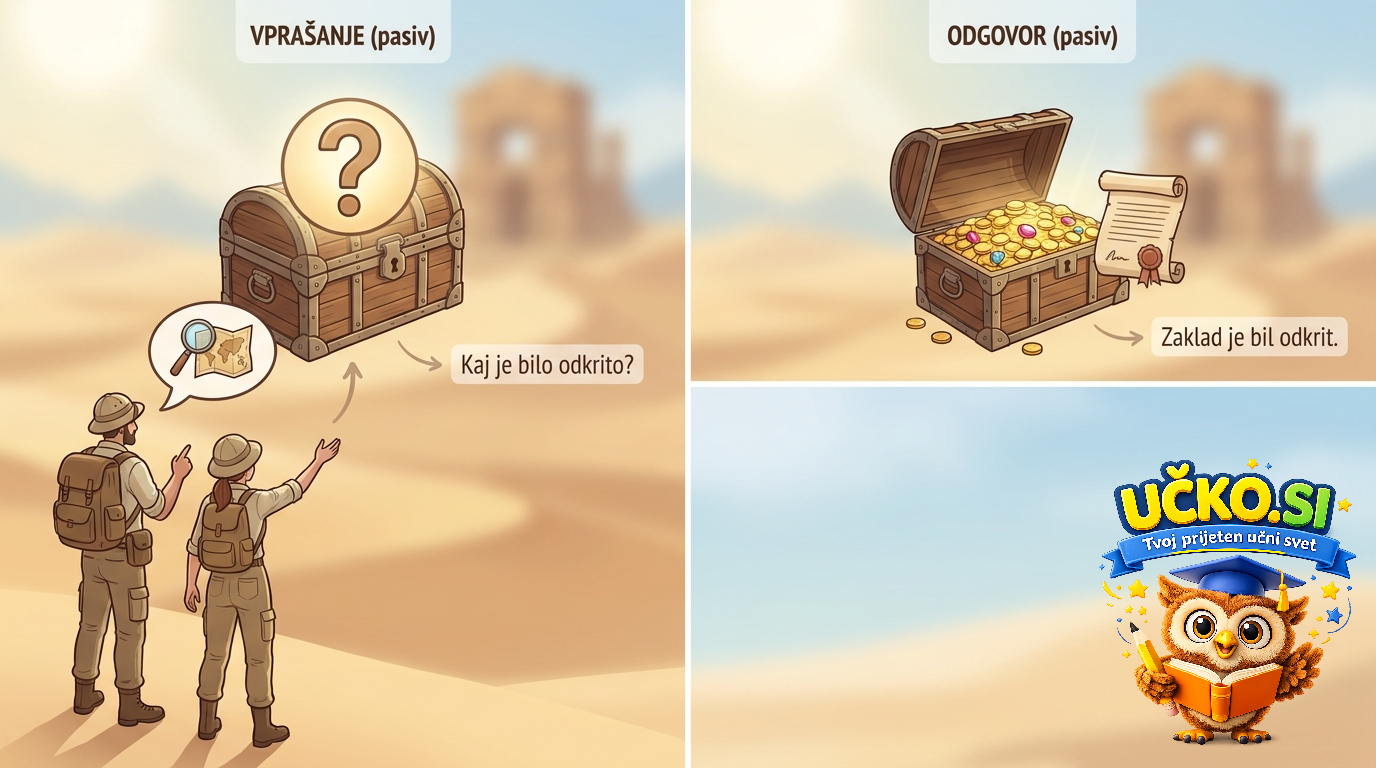
For Wh- questions (like What, Where, When), begin with the Wh- word. After the Wh- word, place the 'to be' verb, then the subject, and finally the past participle. For instance, 'When was America discovered?' is a Wh- question in the passive voice. For 'who' questions about the doer, you can use 'By whom...?' or 'Who... by?'.
- Start with Wh- word.
- Follow with 'to be' verb, subject, and past participle.
Answering Passive Questions
When answering Yes/No passive questions, you can give short answers like 'Yes, it was.' or 'No, they aren't.'. For Wh- questions, provide specific information. For example, if asked 'When was the bridge built?', you might answer 'It was built in 1990.'.
- Use short answers for Yes/No questions.
- Provide specific details for Wh- questions.
Zanimivosti
- The passive voice is used when the action is more important than who or what is doing it.
- The passive voice can be used when the doer is unknown or obvious.
- For formal passive questions about the doer, 'by whom' is used.
Povzetek
We learned how to ask questions in the passive voice using 'to be' + past participle, both for Yes/No and Wh- questions. We also covered how to provide concise answers to these passive questions. Keep practicing to master it!
Pogosta vprašanja
Kaj se naučimo pri temi The passive: questions and answers?
Today, we'll learn how to ask and answer questions using the passive voice. Remember, the passive voice is important when the action is more significant than the person doing it, or when we don't know who did it. It's formed with 'to be' + the past participle.
Kaj je past participle?
Deležnik
Kaj je active voice?
Aktiv
Kaj je passive voice?
Pasiv
Kako na kratko povzamemo temo The passive: questions and answers?
We learned how to ask questions in the passive voice using 'to be' + past participle, both for Yes/No and Wh- questions. We also covered how to provide concise answers to these passive questions. Keep practicing to master it!
Sorodne razlage – Angleščina, 9. razred
- Third conditional
- Too
- Too much/many
- Transport and travelling
- Types of media
- Understanding reference words
- Understanding sentence stress
- Vocabulary development
- Weak forms
- When and while
- Will (for spontaneous decisions)
- Writing skills