Weak forms
Angleščina · 9. razred
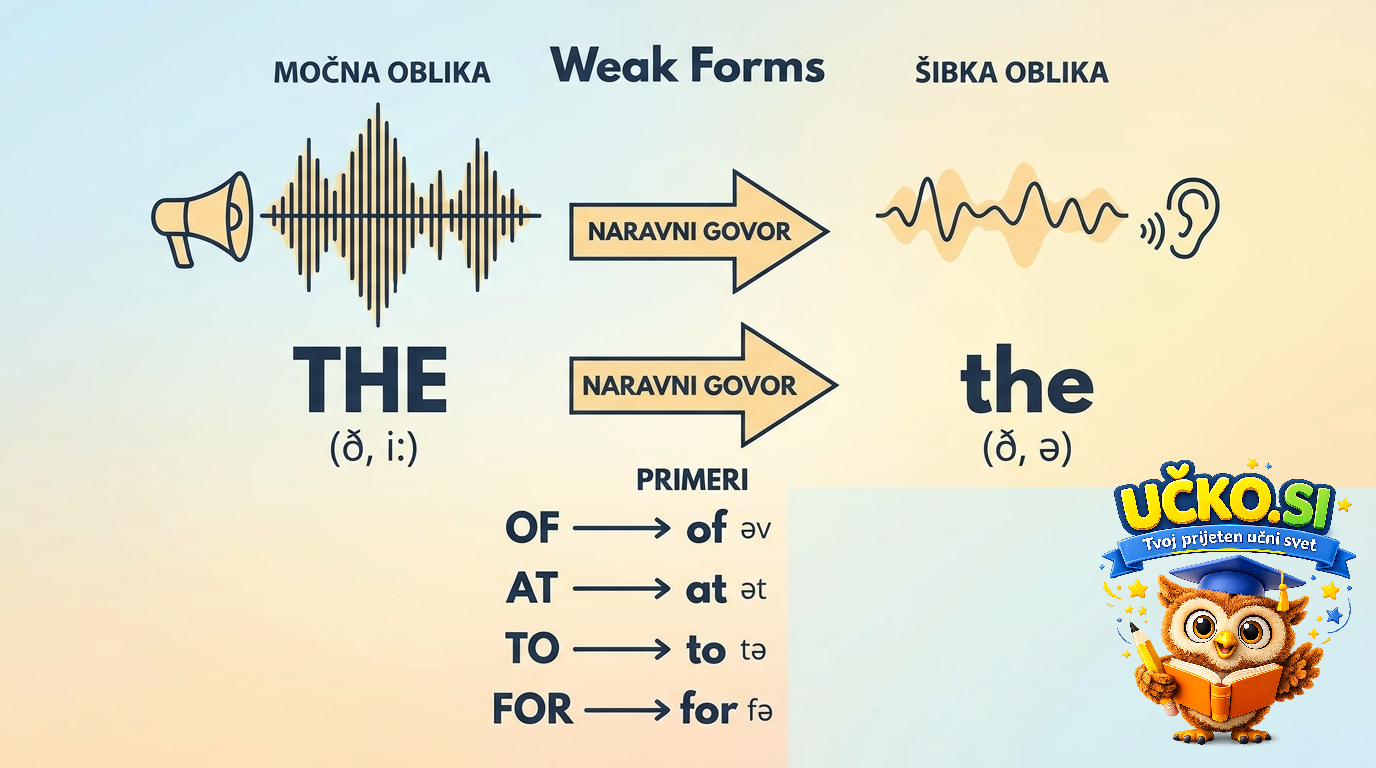
Today, we're learning about "Weak Forms" in English. These are words that sound softer and shorter when we speak naturally. Using them helps you sound more like a native speaker.
Ključni pojmi
- Weak Forms
- Words pronounced softly and shortly in natural speech.
- Schwa sound
- A common 'uh' sound found in many weak forms.
- Strong Forms
- Words pronounced clearly, used for emphasis or at sentence ends.
What are Weak Forms?
Weak forms are small words like 'a', 'the', 'and', 'for', and 'is' that are often pronounced less clearly. When we speak quickly, these words get "reduced" or "weakened." This makes English sound smoother and more natural, just like in Slovenian when you speak fast.
- Small words are often reduced in natural speech.
- They help speech flow smoothly.
Key Weak Form Words and Examples
Many common words have weak forms, often using the "schwa" sound (like 'uh'). For example, 'a' becomes 'uh' (I want 'uh' book), 'the' becomes 'thuh' (Pass me 'thuh' salt), and 'and' can become 'uhn' or 'n' (Fish 'n' chips). Auxiliary verbs like 'is' and 'are' also have weak forms, such as 'He 'z' tall' or 'We 'er' friends'.
- The "schwa" sound is common in weak forms.
- Examples include 'a' (uh), 'the' (thuh), 'and' (n), 'for' (fuh), 'to' (tuh), 'of' (uv), 'is' (z), 'are' (er), 'was' (wuz), and 'have' (uv).
When to Use Strong Forms
Sometimes, we don't use weak forms. Strong forms are used when a word is at the end of a sentence, like in 'Where are you from?'. We also use strong forms when we want to emphasize a word, such as 'I said it's FOR you!' Lastly, strong forms are used when quoting or listing a word, for example, 'How do you spell "of"?'.
- Use strong forms at the end of a sentence.
- Use strong forms for emphasis or when quoting a word.
Zanimivosti
- The "schwa" sound is the most common vowel sound in English.
- Listening to native speakers helps you learn weak forms naturally.
Povzetek
Weak forms make spoken English sound more natural and fluent by reducing small, less important words. They help speech flow better and emphasize important words. Knowing when to use weak and strong forms will improve your English pronunciation.
Pogosta vprašanja
Kaj se naučimo pri temi Weak forms?
Today, we're learning about "Weak Forms" in English. These are words that sound softer and shorter when we speak naturally. Using them helps you sound more like a native speaker.
Kaj je weak forms?
Words pronounced softly and shortly in natural speech.
Kaj je schwa sound?
A common 'uh' sound found in many weak forms.
Kaj je strong forms?
Words pronounced clearly, used for emphasis or at sentence ends.
Kako na kratko povzamemo temo Weak forms?
Weak forms make spoken English sound more natural and fluent by reducing small, less important words. They help speech flow better and emphasize important words. Knowing when to use weak and strong forms will improve your English pronunciation.
Sorodne razlage – Angleščina, 9. razred
- When and while
- Will (for spontaneous decisions)
- Writing skills
- -ed endings
- (Not) enough
- A blog
- A few
- A formal letter
- A lot of
- A news report
- A profile
- A survey report