When and while
Angleščina · 9. razred
Today, we'll learn about 'when' and 'while,' two words that help us talk about actions happening at the same time or one after another. They are very useful for describing events clearly.
Ključni pojmi
- Conjunction
- A connecting word.
- Specific
- Natančen.
- Sudden
- Nenaden.
- Continuous
- Neprekinjen.
- Duration
- Trajanje.
Using 'When'
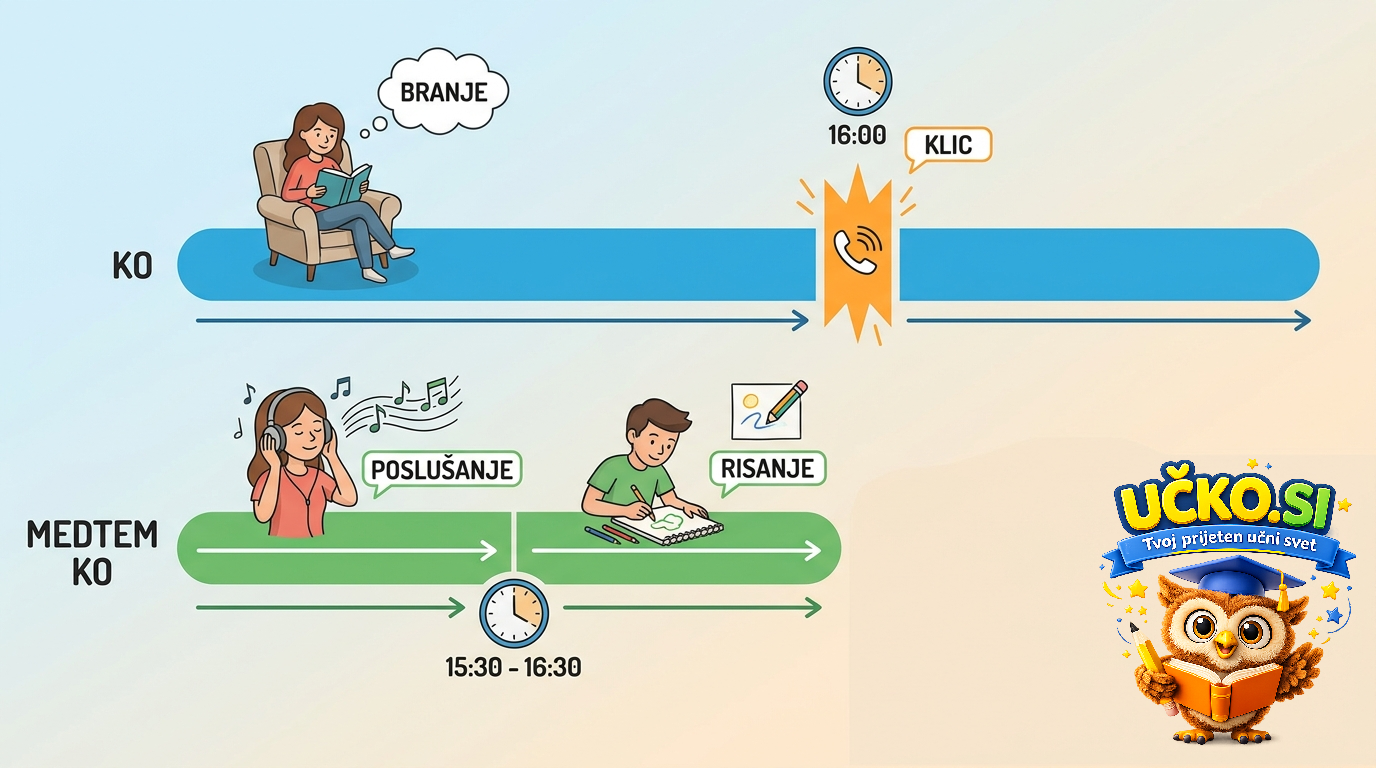
'When' is used for shorter actions, sudden events, or when one action happens after another. It often connects a shorter action in Past Simple with a longer background action in Past Continuous. For example, 'The phone rang when I was eating dinner.' Here, the phone ringing is a sudden, short action.
- For short or sudden actions.
- For actions happening sequentially.
- Often with Past Simple for the 'when' clause.
Using 'While'
'While' describes longer actions or two actions happening simultaneously. It's also used when a longer action is interrupted by a shorter one. For instance, 'I was reading a book while my sister was listening to music' shows two actions happening at the same time. 'While' is almost always followed by a continuous tense.
- For two continuous actions at the same time.
- For a longer action that is interrupted.
- Almost always followed by a continuous tense.
Comparing 'When' and 'While'
Think of 'when' as describing a specific moment, like a flash, while 'while' describes a duration, a period of time. For example, 'When he arrived, we started the party' focuses on a moment. 'My parents were watching TV while I was doing my homework' focuses on ongoing activities.
- 'When' is for specific moments.
- 'While' is for durations.
- They both connect two parts of a sentence.
Zanimivosti
- Both 'when' and 'while' are conjunctions.
- 'When' can introduce a time clause that tells us *when* something else happened.
- 'While' can show two actions happening simultaneously.
Povzetek
'When' is for short, sudden, or sequential actions, often with Past Simple. 'While' is for longer, continuous, or simultaneous actions, usually with a continuous tense. Understanding their differences helps you describe events precisely.
Pogosta vprašanja
Kaj se naučimo pri temi When and while?
Today, we'll learn about 'when' and 'while,' two words that help us talk about actions happening at the same time or one after another. They are very useful for describing events clearly.
Kaj je conjunction?
A connecting word.
Kaj je specific?
Natančen.
Kaj je sudden?
Nenaden.
Kako na kratko povzamemo temo When and while?
'When' is for short, sudden, or sequential actions, often with Past Simple. 'While' is for longer, continuous, or simultaneous actions, usually with a continuous tense. Understanding their differences helps you describe events precisely.
Sorodne razlage – Angleščina, 9. razred
- Will (for spontaneous decisions)
- Writing skills
- -ed endings
- (Not) enough
- A blog
- A few
- A formal letter
- A lot of
- A news report
- A profile
- A survey report
- A/an