Transport and travelling
Angleščina · 9. razred
Hello, Grade 9 students! Today we're learning about how we move from place to place, which is called transport, and the act of travelling. This topic is useful because we all travel for school, friends, or holidays.
Ključni pojmi
- Trip
- A journey to a place and back again, often for pleasure.
- Journey
- The act of travelling from one place to another.
- Destination
- The place where someone is going or where something is sent.
- Departure
- The act of leaving a place.
- Arrival
- The act of reaching a place.
Modes of Transport
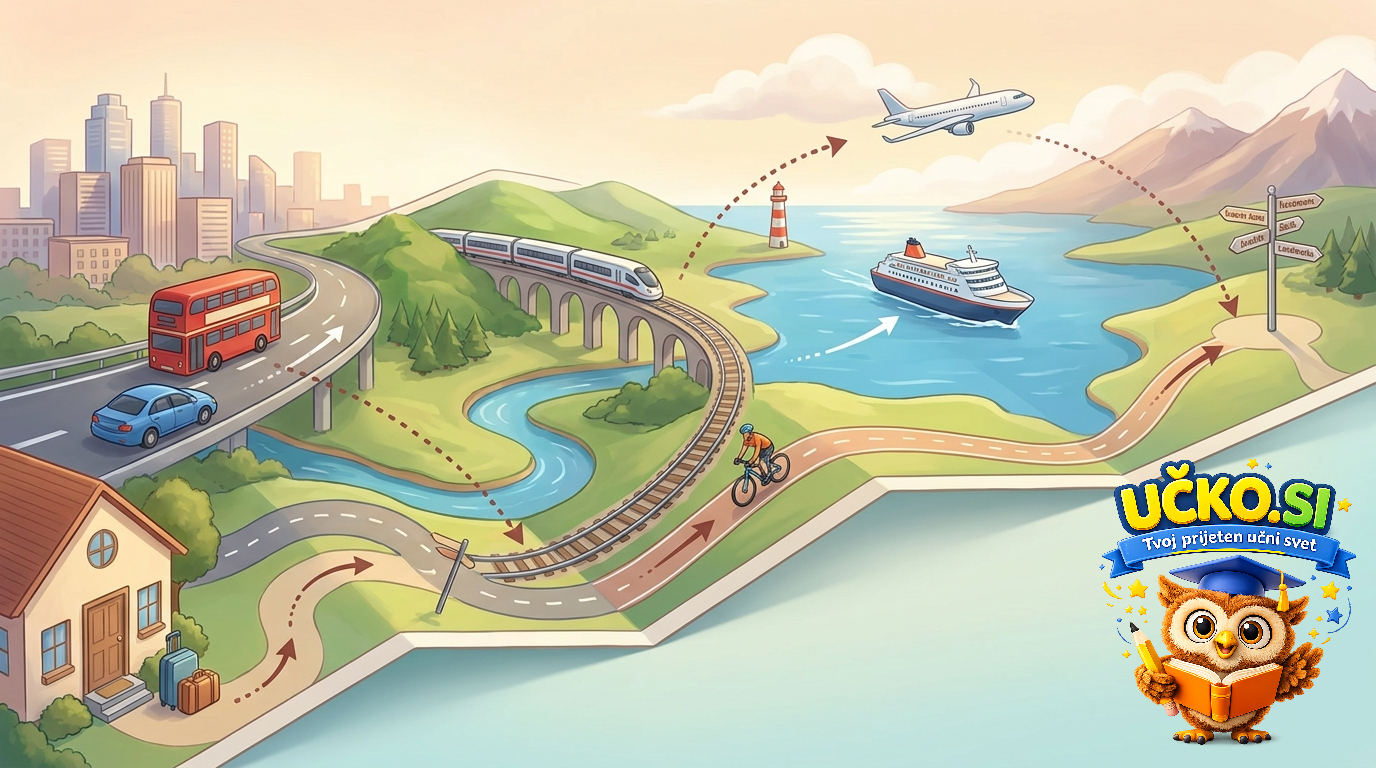
There are different ways to travel. Land transport includes cars, buses, trains, bicycles, and motorbikes. For air transport, we usually use aeroplanes or helicopters. Water transport involves boats, ships, and ferries. Public transport refers to services like buses, trains, trams, and the metro, which are available to everyone.
- Land transport includes cars, buses, trains, bicycles.
- Air transport uses aeroplanes or helicopters.
- Water transport involves boats, ships, and ferries.
Travelling Vocabulary
When we travel, we use specific words. A 'trip' is a journey often for pleasure, while a 'journey' is the act of travelling from one place to another. Your 'destination' is where you are going. 'Departure' means leaving, and 'arrival' means reaching a place. You need a 'ticket' to travel and a 'passport' for international trips. 'Luggage' is your bags, and a 'boarding pass' lets you get on a plane or ship.
- A trip is often for pleasure, a journey is the act of travelling.
- Departure is leaving, arrival is reaching a place.
- A ticket allows travel, a passport is for international trips.
Prepositions for Movement
We use prepositions to talk about how we travel. Use 'by' with the mode of transport, for example, 'by bus' or 'by train.' However, we say 'on foot' if we are walking. For public transport where you can stand, use 'on,' like 'on the bus,' but use 'in' for cars. Use 'to' before a destination, such as 'going to Rome.'
- Use 'by' for modes of transport (e.g., by bus, by train).
- Say 'on foot' for walking.
- Use 'on' for public transport where you can stand, 'in' for cars, and 'to' for destinations.
Zanimivosti
- Using public transport is often cheaper than driving a car.
- The train journey from Ljubljana to Maribor takes about two hours.
- Many people travel by plane for international holidays.
Povzetek
We learned about different ways to travel, like land, air, and water transport, including public options. We also explored key vocabulary for travelling and important prepositions like 'by,' 'on,' and 'to' when discussing movement.
Pogosta vprašanja
Kaj se naučimo pri temi Transport and travelling?
Hello, Grade 9 students! Today we're learning about how we move from place to place, which is called transport, and the act of travelling. This topic is useful because we all travel for school, friends, or holidays.
Kaj je trip?
A journey to a place and back again, often for pleasure.
Kaj je journey?
The act of travelling from one place to another.
Kaj je destination?
The place where someone is going or where something is sent.
Kako na kratko povzamemo temo Transport and travelling?
We learned about different ways to travel, like land, air, and water transport, including public options. We also explored key vocabulary for travelling and important prepositions like 'by,' 'on,' and 'to' when discussing movement.
Kje najdem vaje in vprašanja za temo Transport and travelling?
Za temo Transport and travelling (Angleščina, 9. razred) so v aplikaciji Učko.si kviz z vprašanji in odgovori ter vaje za preverjanje znanja.
Sorodne razlage – Angleščina, 9. razred
- Types of media
- Understanding reference words
- Understanding sentence stress
- Vocabulary development
- Weak forms
- When and while
- Will (for spontaneous decisions)
- Writing skills
- -ed endings
- (Not) enough
- A blog
- A few