Relative pronouns
Angleščina · 9. razred
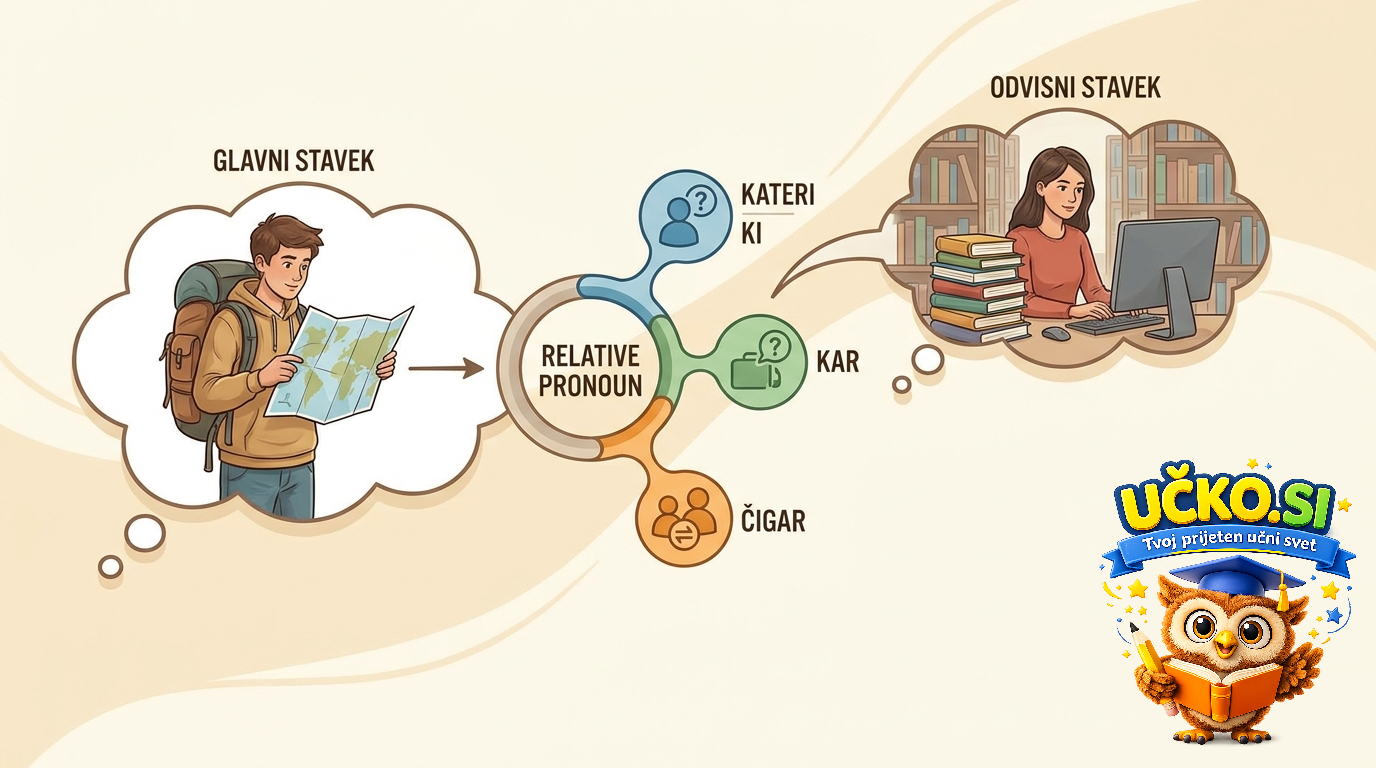
Relative pronouns help us make sentences more interesting and connected. They introduce relative clauses, which give more information about a noun. Think of them as linking words that join parts of a sentence.
Ključni pojmi
- Relative pronoun
- A word that introduces a relative clause.
- Relative clause
- Gives more information about a noun.
- Defining clause
- Essential information, no commas.
- Non-defining clause
- Extra information, uses commas.
- Possession
- Shows belonging (e.g., 'whose').
Main Relative Pronouns
The most common relative pronouns are 'who', 'whom', 'whose', 'which', and 'that'. 'Who' is for people, while 'which' is for things, animals, or ideas. 'Whose' shows possession, and 'whom' is for people, usually as an object or after a preposition. 'That' is very versatile and can be used for people, animals, or things.
- 'Who' is for people (subject).
- 'Which' is for things, animals, or ideas.
- 'Whose' shows possession.
Using 'Whom' and 'That'
'Whom' is used when the person is the object of the verb or after a preposition, though it's less common in everyday English. 'That' can be used for people, animals, or things and is often interchangeable with 'who' or 'which' in informal English. It's especially common in defining clauses.
- 'Whom' is an object form for people.
- 'That' can be used for people, animals, or things.
- 'That' is versatile and often used in defining clauses.
Defining vs. Non-defining Clauses
Defining clauses are essential for the sentence's meaning and do not use commas. Non-defining clauses add extra, non-essential information and are set off by commas. You cannot use 'that' in non-defining clauses, only 'who', 'whom', 'whose', or 'which'.
- Defining clauses are essential and use no commas.
- Non-defining clauses add extra info and use commas.
- Do not use 'that' in non-defining clauses.
Zanimivosti
- 'That' is very versatile and can be used for people, animals, or things.
- You cannot use 'that' in non-defining clauses.
Povzetek
Relative pronouns connect parts of sentences by giving more information about a noun. They include 'who', 'whom', 'whose', 'which', and 'that'. Understanding defining and non-defining clauses helps you use these pronouns correctly to write better sentences.
Pogosta vprašanja
Kaj se naučimo pri temi Relative pronouns?
Relative pronouns help us make sentences more interesting and connected. They introduce relative clauses, which give more information about a noun. Think of them as linking words that join parts of a sentence.
Kaj je relative pronoun?
A word that introduces a relative clause.
Kaj je relative clause?
Gives more information about a noun.
Kaj je defining clause?
Essential information, no commas.
Kako na kratko povzamemo temo Relative pronouns?
Relative pronouns connect parts of sentences by giving more information about a noun. They include 'who', 'whom', 'whose', 'which', and 'that'. Understanding defining and non-defining clauses helps you use these pronouns correctly to write better sentences.
Sorodne razlage – Angleščina, 9. razred
- Remembering what you hear
- Reported offers, requests, suggestions and commands
- Reported speech
- Scanning for specific information
- Second conditional
- Sentence stress
- Short /ɒ/ and long /ɔ:/
- Skills and abilities
- Some/any
- Speaking strategies
- Subject and object questions
- Superlative adjectives