Relative clauses
Angleščina · 9. razred
Relative clauses give us more information about a noun. They act like descriptive tags to make our sentences more detailed. These clauses always start with special words called relative pronouns or relative adverbs.
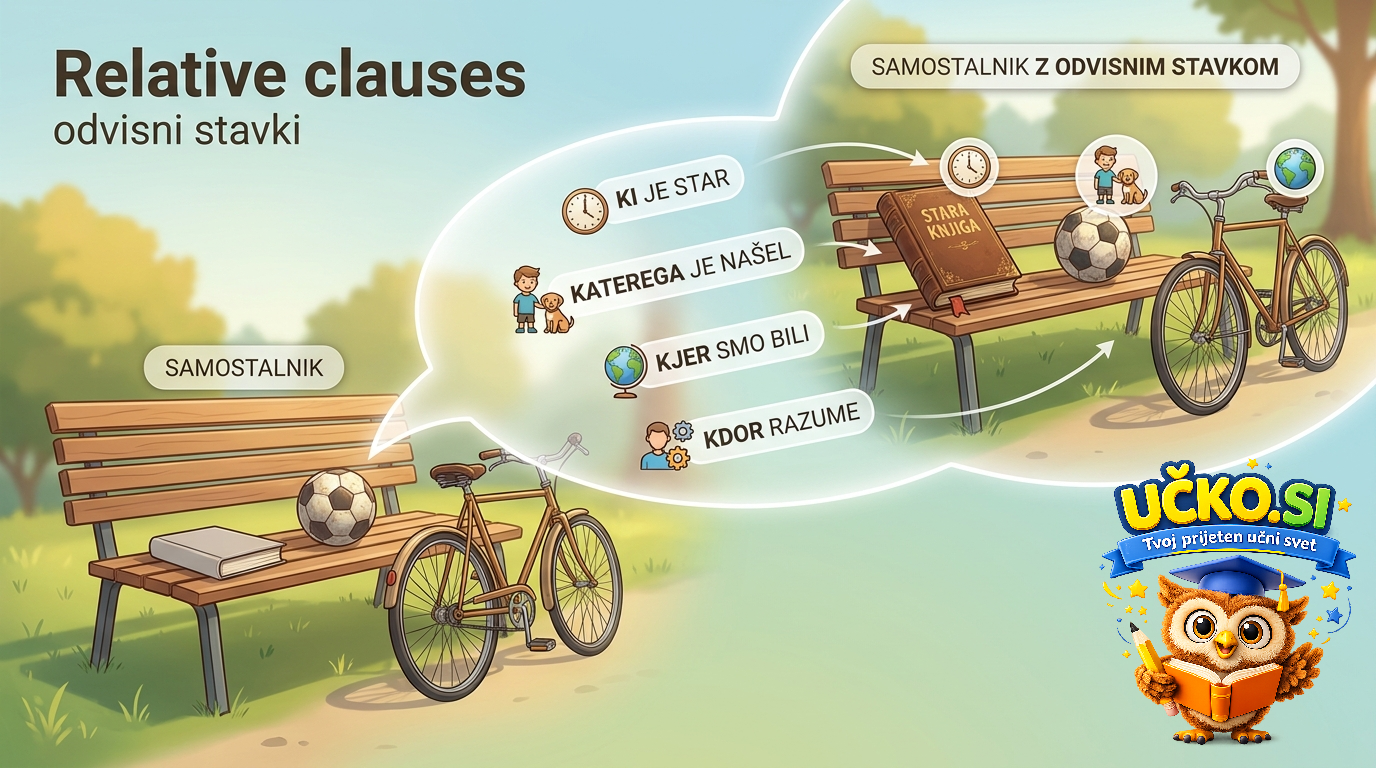
Ključni pojmi
- Relative Clause
- A part of a sentence that gives more information about a noun.
- Relative Pronoun
- Words like 'who', 'which', 'that', 'whose', 'whom' that start relative clauses.
- Relative Adverb
- Words like 'where', 'when', 'why' that start relative clauses for places, times, or reasons.
- Defining Clause
- Essential information, no commas.
- Non-defining Clause
- Extra information, separated by commas.
Relative Pronouns: Who, Which, That, Whose, Whom
Relative pronouns connect a relative clause to a noun. We use 'who' for people and 'which' for things or animals. 'That' can be used for people, things, or animals and is often less formal. 'Whose' shows possession, and 'whom' is a very formal word for people when they are the object.
- 'Who' is for people, 'which' is for things/animals.
- 'That' can be used for people, things, or animals.
- 'Whose' shows possession.
Relative Adverbs: Where, When, Why
Relative adverbs introduce relative clauses that give more information about places, times, or reasons. 'Where' is used for places, like 'This is the park where we play football.' 'When' is used for times, and 'why' is used for reasons. They help us understand more about the context.
- 'Where' is for places.
- 'When' is for times.
- 'Why' is for reasons.
Defining vs. Non-defining Relative Clauses
Defining relative clauses are essential for the sentence's meaning and don't use commas. If you remove them, the meaning changes. Non-defining clauses give extra, non-essential information and are separated by commas. The sentence still makes sense without them.
- Defining clauses are essential and have no commas.
- Non-defining clauses add extra information and use commas.
- 'That' cannot be used in non-defining relative clauses.
Zanimivosti
- Relative clauses make your English sound more natural and detailed.
- In most cases, you can use 'who' or 'that' instead of 'whom', or even omit the pronoun if it's the object.
- 'That' is often more informal than 'who' or 'which'.
Povzetek
Relative clauses add information to nouns, starting with relative pronouns or adverbs. They can be defining (essential, no commas) or non-defining (extra information, with commas). Understanding them helps you create more detailed and natural English sentences.
Pogosta vprašanja
Kaj se naučimo pri temi Relative clauses?
Relative clauses give us more information about a noun. They act like descriptive tags to make our sentences more detailed. These clauses always start with special words called relative pronouns or relative adverbs.
Kaj je relative clause?
A part of a sentence that gives more information about a noun.
Kaj je relative pronoun?
Words like 'who', 'which', 'that', 'whose', 'whom' that start relative clauses.
Kaj je relative adverb?
Words like 'where', 'when', 'why' that start relative clauses for places, times, or reasons.
Kako na kratko povzamemo temo Relative clauses?
Relative clauses add information to nouns, starting with relative pronouns or adverbs. They can be defining (essential, no commas) or non-defining (extra information, with commas). Understanding them helps you create more detailed and natural English sentences.
Kje najdem vaje in vprašanja za temo Relative clauses?
Za temo Relative clauses (Angleščina, 9. razred) so v aplikaciji Učko.si kviz z vprašanji in odgovori ter vaje za preverjanje znanja.
Sorodne razlage – Angleščina, 9. razred
- Relative pronouns
- Remembering what you hear
- Reported offers, requests, suggestions and commands
- Reported speech
- Scanning for specific information
- Second conditional
- Sentence stress
- Short /ɒ/ and long /ɔ:/
- Skills and abilities
- Some/any
- Speaking strategies
- Subject and object questions