Reacting to news
Angleščina · 9. razred
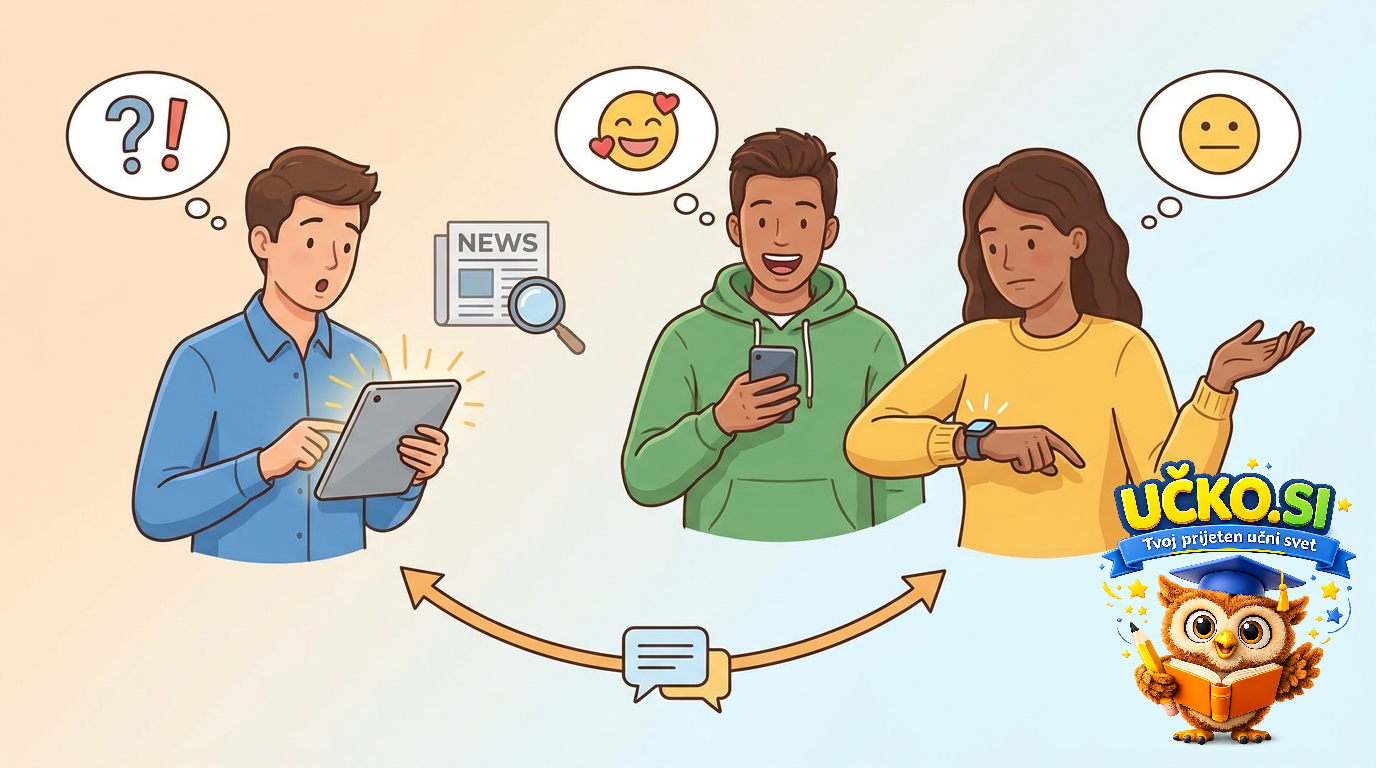
Today we learn how to talk about news and share our feelings in English. It's important to express yourself clearly when you hear interesting or important information. We will cover vocabulary, ways to share news, and how to react.
Ključni pojmi
- News
- Information about recent events.
- Reliable
- Trustworthy; you can believe it.
- Opinion
- What someone thinks or feels about something.
- Fact
- Something that is known to be true.
- Present Perfect
- A verb tense connecting a past event to the present.
Sharing and Reacting to News
When you hear news, you can say 'I heard that...', 'I read that...', or 'I saw on the news that...'. After hearing it, you often have feelings. Express positive feelings with 'That's great!' or 'I'm so happy to hear that.' For negative news, say 'That's terrible!' or 'I'm so sorry to hear that.'
- Use phrases like 'I heard that...' to share news.
- Express positive feelings with phrases like 'That's great!'
- Express negative feelings with phrases like 'That's terrible!'
Neutral Reactions and Grammar
Sometimes you might feel surprised or neutral. You can ask 'Really?' or 'Is that true?' if you are unsure. For grammar, we often use the Present Perfect tense to talk about news, connecting a past event to the present. For example, 'I have heard that the new park has opened.'
- Use 'Really?' or 'Is that true?' for surprise or uncertainty.
- The Present Perfect tense (have/has + past participle) is used for news.
- The Present Perfect connects a past event to the present importance.
Checking News Reliability
It's important to think if the news you hear is true. Always ask, 'Is the source reliable?' A reliable source is trustworthy. Also consider, 'Is it a fact or an opinion?' Facts are known to be true, while opinions are what someone thinks.
- Always check if the news source is reliable.
- Distinguish between a fact (known true) and an opinion (what someone thinks).
- Be careful about believing unreliable information.
Zanimivosti
- Headline is the title of a news article.
- A report is a spoken or written account of something.
- Source is where the news comes from, like TV or internet.
Povzetek
This lesson taught us how to share and react to news using specific English phrases. We also learned about the Present Perfect tense for news and the importance of checking if news is reliable. Being able to express your feelings about news clearly is a helpful skill.
Pogosta vprašanja
Kaj se naučimo pri temi Reacting to news?
Today we learn how to talk about news and share our feelings in English. It's important to express yourself clearly when you hear interesting or important information. We will cover vocabulary, ways to share news, and how to react.
Kaj je news?
Information about recent events.
Kaj je reliable?
Trustworthy; you can believe it.
Kaj je opinion?
What someone thinks or feels about something.
Kako na kratko povzamemo temo Reacting to news?
This lesson taught us how to share and react to news using specific English phrases. We also learned about the Present Perfect tense for news and the importance of checking if news is reliable. Being able to express your feelings about news clearly is a helpful skill.
Kje najdem vaje in vprašanja za temo Reacting to news?
Za temo Reacting to news (Angleščina, 9. razred) so v aplikaciji Učko.si kviz z vprašanji in odgovori ter vaje za preverjanje znanja.
Sorodne razlage – Angleščina, 9. razred
- Reading for gist/skimming
- Reading strategies
- Recognising contractions
- Recognising informal speech
- Relative clauses
- Relative pronouns
- Remembering what you hear
- Reported offers, requests, suggestions and commands
- Reported speech
- Scanning for specific information
- Second conditional
- Sentence stress