Recognising contractions
Angleščina · 9. razred
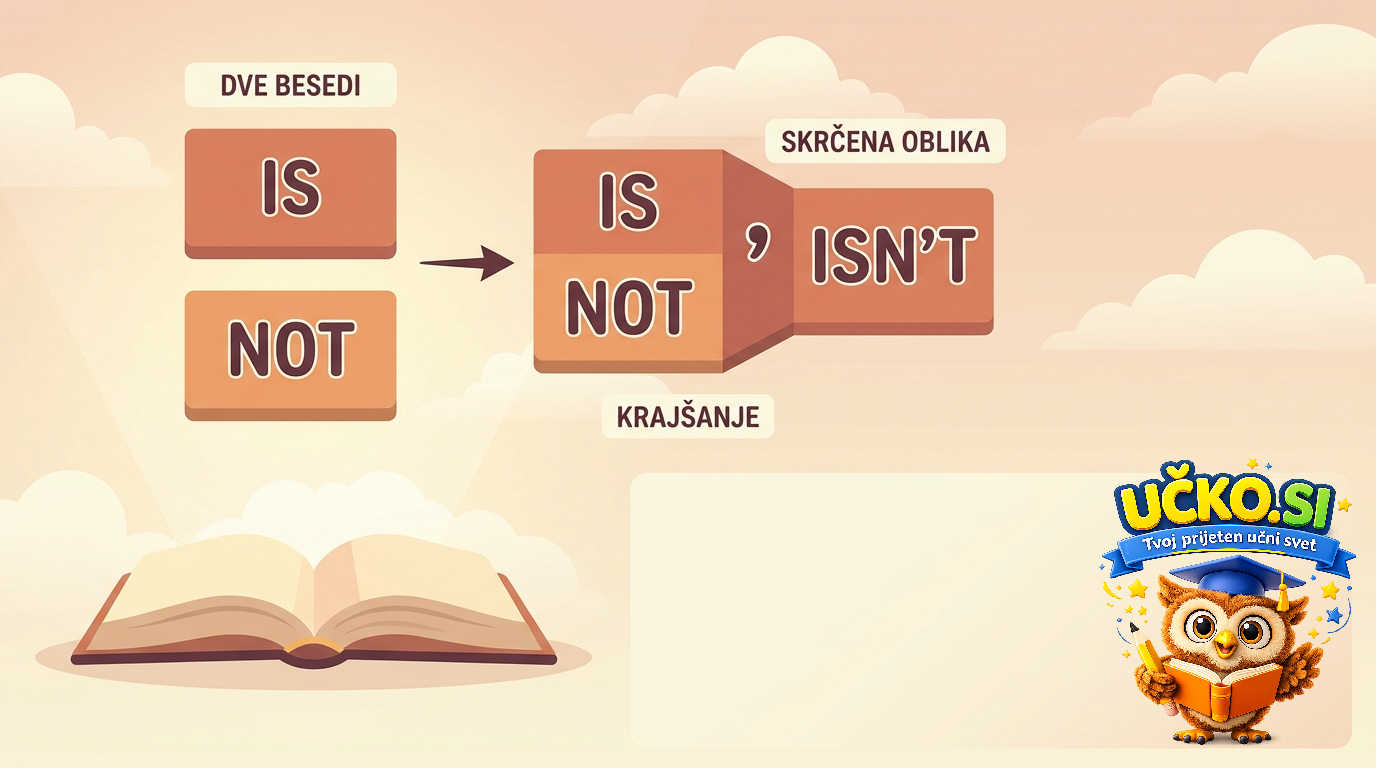
Contractions are shortened forms of two words combined into one, common in everyday English. They make language sound more natural and are used in both speaking and informal writing. An apostrophe replaces missing letters in a contraction.
Ključni pojmi
- Contraction
- A shortened form of two words combined into one, with an apostrophe replacing missing letters.
- Apostrophe
- A punctuation mark (') used in contractions to show where letters have been removed.
- Informal writing
- A style of writing typically used in casual communication, where contractions are common.
What are Contractions and Why We Use Them
A contraction is a shortened form of two words combined, where one or more letters are removed and replaced by an apostrophe ('). We use contractions to speak faster and more naturally, and to write more informally. They are very common in conversations and friendly communication like letters or emails.
- Contractions shorten two words into one.
- An apostrophe shows where letters are missing.
- Used for faster, more natural speech and informal writing.
Common Contractions with 'to be' and 'have' verbs
Many contractions are formed with 'to be' verbs like 'is' and 'are', and 'have' verbs. For example, 'is + not' becomes 'isn't', and 'I + have' becomes 'I've'. Be careful with words that sound similar but have different meanings, such as 'it's' (it is / it has) and 'its' (belonging to it).
- Contractions with 'to be' verbs: isn't, aren't, I'm not, he's, she's, it's, we're, you're, they're.
- Contractions with 'have' verbs: haven't, hasn't, I've, we've, you've, they've.
- 'He's', 'she's', and 'it's' can mean 'he is', 'she is', 'it is' OR 'he has', 'she has', 'it has'.
Other Common Contractions
Contractions are also formed with 'will', 'would', 'should', 'could', 'did', and 'do'. For example, 'will + not' becomes 'won't', and 'do + not' becomes 'don't'. Remember that 'won't' is an irregular contraction for 'will not'.
- Contractions with 'will': I'll, you'll, he'll, she'll, it'll, we'll, they'll, won't (will not).
- Contractions with 'would', 'should', 'could': wouldn't, shouldn't, couldn't.
- Contractions with 'did' and 'do': didn't, don't, doesn't.
Zanimivosti
- Contractions make our language sound more natural and fluent.
- 'Won't' is an irregular contraction for 'will not'.
- In formal writing, it's usually better to use the full, uncontracted forms of words.
Povzetek
Contractions are shortened word forms using an apostrophe, making English more natural and informal. They are common in speech and casual writing. Always distinguish contractions from similar-sounding words like 'its' and 'it's'.
Pogosta vprašanja
Kaj se naučimo pri temi Recognising contractions?
Contractions are shortened forms of two words combined into one, common in everyday English. They make language sound more natural and are used in both speaking and informal writing. An apostrophe replaces missing letters in a contraction.
Kaj je contraction?
A shortened form of two words combined into one, with an apostrophe replacing missing letters.
Kaj je apostrophe?
A punctuation mark (') used in contractions to show where letters have been removed.
Kaj je informal writing?
A style of writing typically used in casual communication, where contractions are common.
Kako na kratko povzamemo temo Recognising contractions?
Contractions are shortened word forms using an apostrophe, making English more natural and informal. They are common in speech and casual writing. Always distinguish contractions from similar-sounding words like 'its' and 'it's'.
Sorodne razlage – Angleščina, 9. razred
- Recognising informal speech
- Relative clauses
- Relative pronouns
- Remembering what you hear
- Reported offers, requests, suggestions and commands
- Reported speech
- Scanning for specific information
- Second conditional
- Sentence stress
- Short /ɒ/ and long /ɔ:/
- Skills and abilities
- Some/any