Question tags
Angleščina · 9. razred
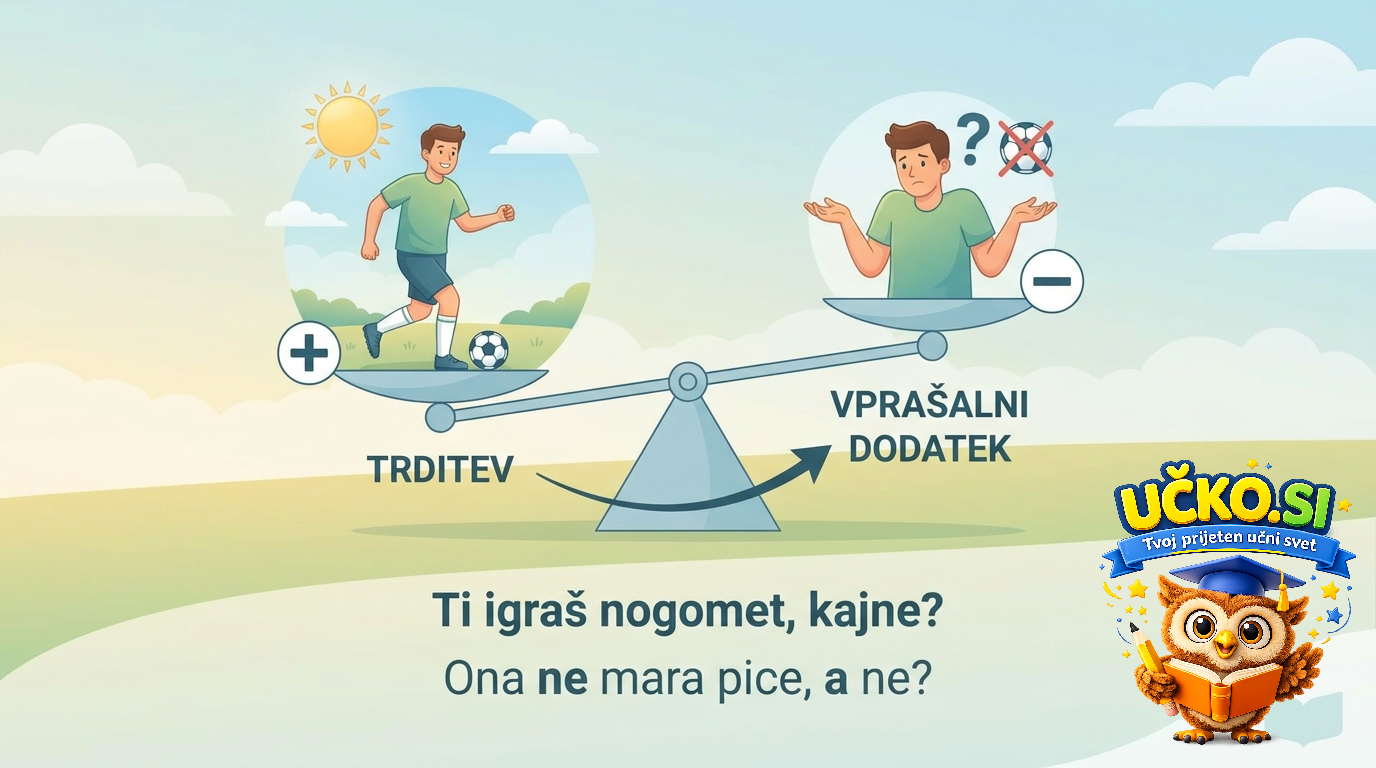
Hello, young learners! Today we're learning about question tags. These are short questions added to the end of a statement to ask for confirmation or check agreement, like saying 'right?' in Slovenian.
Ključni pojmi
- Question tags
- Short questions added to the end of a statement.
- Auxiliary verb
- A helping verb used in a statement or tag.
- Pronoun
- A word used instead of a noun (e.g., she, they).
- Intonation
- The rise and fall of the voice in speaking.
Basic Rules for Forming Question Tags
When the main statement is positive, the question tag is negative (e.g., 'You are happy, aren't you?'). If the statement is negative, the tag is positive (e.g., 'You aren't sad, are you?'). Always use a pronoun in the tag, not a noun, and keep the auxiliary verb the same.
- Positive statement → Negative tag
- Negative statement → Positive tag
- Use a pronoun in the tag
Using Auxiliary Verbs and Special Cases
The auxiliary verb in the tag matches the one in the statement. If there's no auxiliary verb (like in Simple Present or Past), use 'do,' 'does,' or 'did.' Remember, 'I am' uses 'aren't I?', 'Let's' uses 'shall we?', and commands often use 'will you?'.
- Use same auxiliary verb
- Use 'do/does/did' if no auxiliary verb
- Special tags for 'I am', 'Let's', and imperatives
Intonation and Practice
Your voice goes down at the end of the tag if you expect agreement. If you're genuinely asking a question and are unsure, your voice goes up. Practicing these rules will help you sound more natural when speaking English.
- Voice down for expected agreement
- Voice up for genuine questions
- Practice improves fluency
Zanimivosti
- Question tags are like saying 'right?' or 'isn't it?' in Slovenian.
- The tag for 'I am' is 'aren't I?'.
- For commands, we often use 'will you?' as the tag.
Povzetek
Question tags are short questions at the end of statements, used for confirmation. They follow rules like positive statements having negative tags and vice versa, and using the same auxiliary verb or 'do/does/did'. Intonation changes based on whether you expect agreement or are genuinely asking.
Pogosta vprašanja
Kaj se naučimo pri temi Question tags?
Hello, young learners! Today we're learning about question tags. These are short questions added to the end of a statement to ask for confirmation or check agreement, like saying 'right?' in Slovenian.
Kaj je question tags?
Short questions added to the end of a statement.
Kaj je auxiliary verb?
A helping verb used in a statement or tag.
Kaj je pronoun?
A word used instead of a noun (e.g., she, they).
Kako na kratko povzamemo temo Question tags?
Question tags are short questions at the end of statements, used for confirmation. They follow rules like positive statements having negative tags and vice versa, and using the same auxiliary verb or 'do/does/did'. Intonation changes based on whether you expect agreement or are genuinely asking.
Kje najdem vaje in vprašanja za temo Question tags?
Za temo Question tags (Angleščina, 9. razred) so v aplikaciji Učko.si kviz z vprašanji in odgovori ter vaje za preverjanje znanja.
Sorodne razlage – Angleščina, 9. razred
- Questions and question forms
- Reacting to news
- Reading for gist/skimming
- Reading strategies
- Recognising contractions
- Recognising informal speech
- Relative clauses
- Relative pronouns
- Remembering what you hear
- Reported offers, requests, suggestions and commands
- Reported speech
- Scanning for specific information