Present tenses
Angleščina · 9. razred
Hello, Grade 9 students! We use present tenses to talk about things happening now, things that happen regularly, and general truths. There are four main present tenses in English that help us express different timings and meanings.
Ključni pojmi
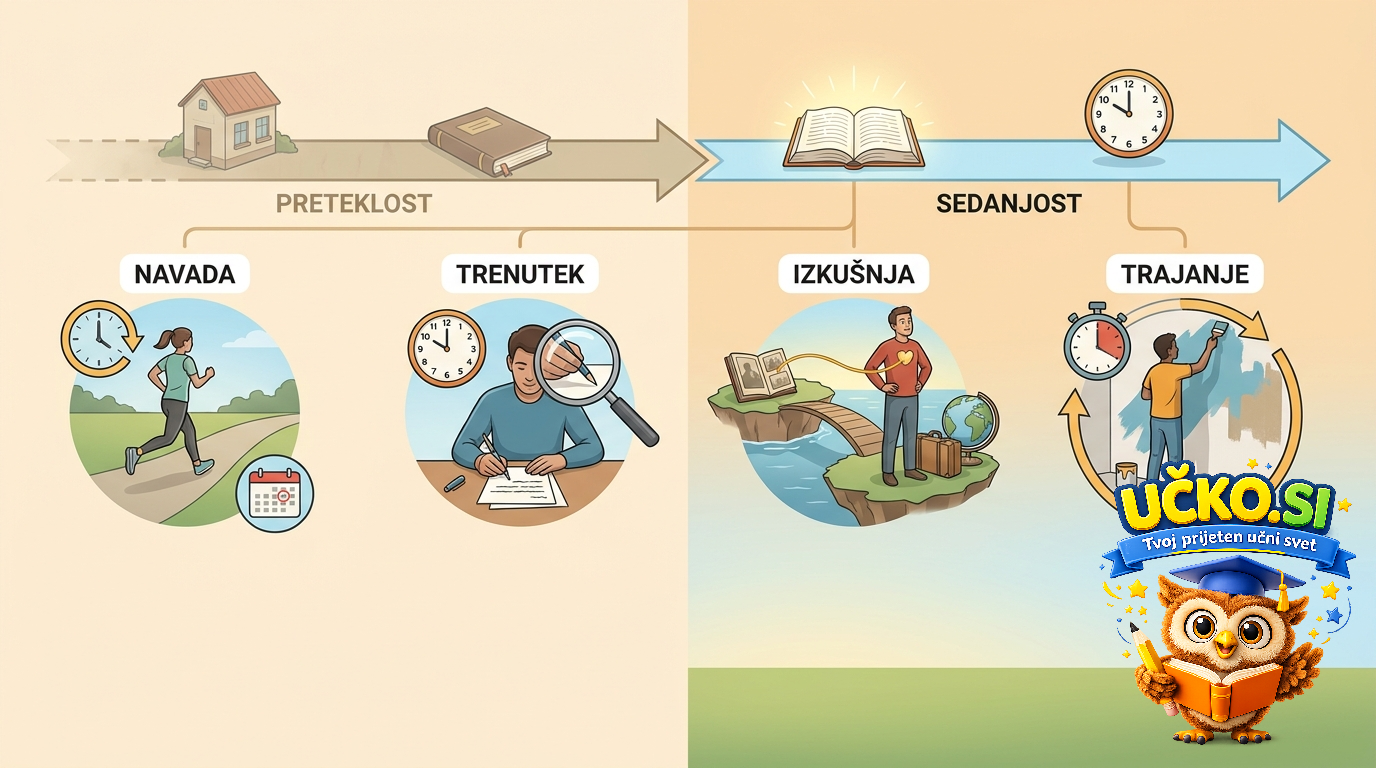
- Present Simple
- Used for habits, general truths, and scheduled future events.
- Present Continuous
- Used for actions happening now, temporary actions, or developing situations.
- Present Perfect
- Used for actions that started in the past and continue to the present, or past experiences.
- Present Perfect Continuous
- Used for actions that started in the past and are still continuing, focusing on duration.
- Stative verbs
- Verbs that are usually not used in continuous forms (e.g., love, know).
Present Simple & Continuous
The Present Simple describes habits, routines, general truths, and scheduled future events. For example, 'The sun rises in the east.' The Present Continuous describes actions happening right now, temporary actions, or developing situations. An example is, 'I am reading a book.'
- Present Simple: habits, general truths, scheduled future.
- Present Continuous: actions happening now, temporary actions.
- Stative verbs usually don't use continuous form.
Present Perfect & Perfect Continuous
The Present Perfect is used for actions that started in the past and continue to the present, past experiences, or recently completed actions with a present result. For instance, 'I have lived in Slovenia for ten years.' The Present Perfect Continuous focuses on actions that started in the past and are still continuing, emphasizing duration, or recently finished actions with visible results. An example is, 'She is tired because she has been running.'
- Present Perfect: past actions continuing now, experiences, recent actions with results.
- Present Perfect Continuous: actions continuing with focus on duration, recent activities with results.
- Keywords like 'for' and 'since' are common for both perfect tenses.
Zanimivosti
- The Present Simple can be used for future scheduled events like 'The train leaves at 7 PM.'
- Some verbs, called stative verbs, are usually not used in the continuous form, such as 'love' or 'know'.
Povzetek
We explored the four present tenses: Simple, Continuous, Perfect, and Perfect Continuous. Each tense has specific uses and formation rules to help us express different meanings related to the present time. Practice using them to improve your English!
Pogosta vprašanja
Kaj se naučimo pri temi Present tenses?
Hello, Grade 9 students! We use present tenses to talk about things happening now, things that happen regularly, and general truths. There are four main present tenses in English that help us express different timings and meanings.
Kaj je present simple?
Used for habits, general truths, and scheduled future events.
Kaj je present continuous?
Used for actions happening now, temporary actions, or developing situations.
Kaj je present perfect?
Used for actions that started in the past and continue to the present, or past experiences.
Kako na kratko povzamemo temo Present tenses?
We explored the four present tenses: Simple, Continuous, Perfect, and Perfect Continuous. Each tense has specific uses and formation rules to help us express different meanings related to the present time. Practice using them to improve your English!
Sorodne razlage – Angleščina, 9. razred
- Present tenses with future meaning
- Pronunciation and fluency
- Quantifiers and determiners
- Quantifiers: too, too much/many, (not) enough, a/an, some/any, much/many, a few, a lot of
- Question tags
- Questions and question forms
- Reacting to news
- Reading for gist/skimming
- Reading strategies
- Recognising contractions
- Recognising informal speech
- Relative clauses