Present tenses with future meaning
Angleščina · 9. razred
Hello, English learners! Did you know that we can use present tenses to talk about the future? This lesson will show you how to use the present simple and present continuous for future events.
Ključni pojmi
- schedule
- A plan of activities or events and when they will happen.
- timetable
- A list of times at which events are planned to happen, for example, for trains or classes.
- arrangements
- Plans or preparations made for a future event.
- plans
- Detailed proposals for doing or achieving something.
Present Simple for Future Events
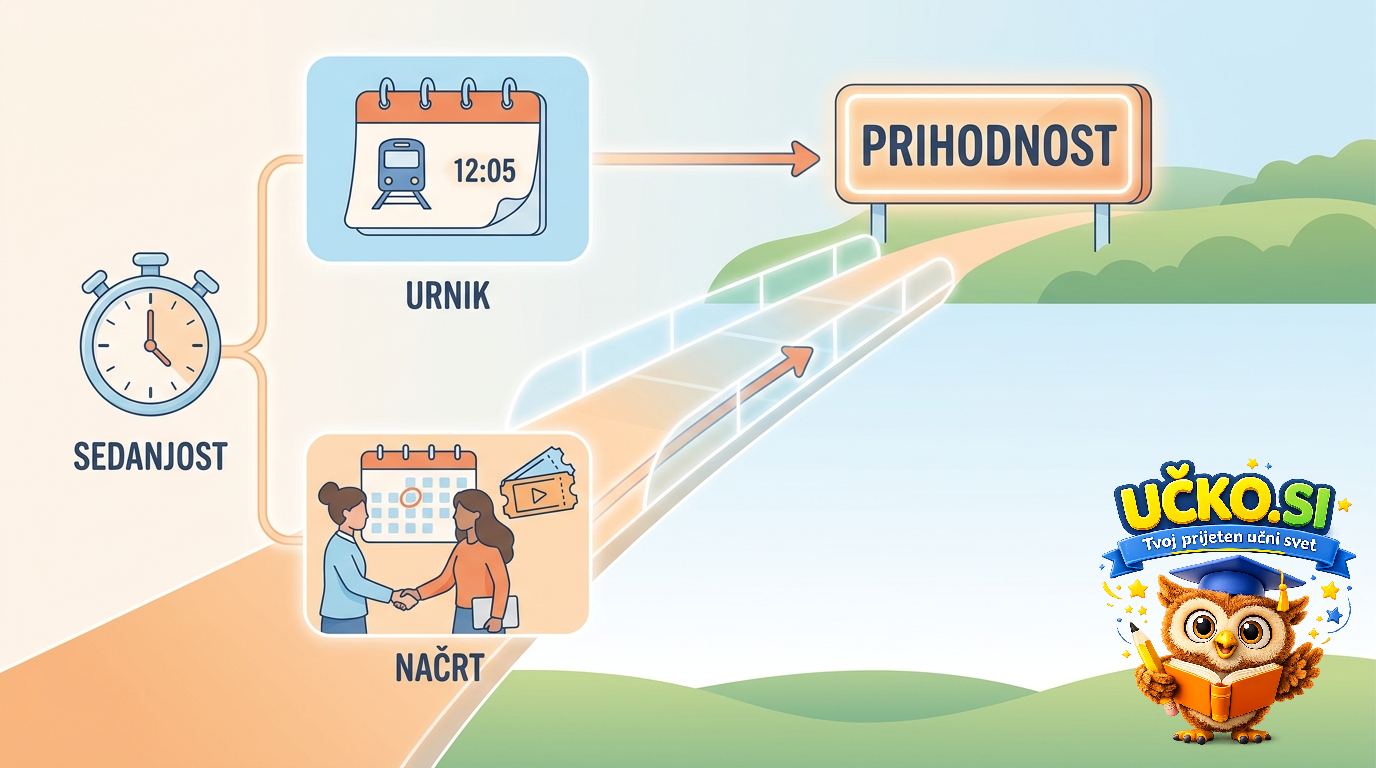
We use the present simple tense for future events that are part of a fixed schedule, timetable, or programme. These are planned events like train times or school lessons. It's like looking at a calendar entry for something that happens regularly.
- Used for fixed schedules or timetables.
- Examples: train departures, class starts.
Present Continuous for Future Events
The present continuous tense is for future plans or arrangements you have already made. These are personal plans, often organised with others, showing you've decided and prepared for something. Think of it as already having organised an event.
- Used for personal, pre-arranged plans.
- Examples: meeting friends, having a party.
Key Differences
The main difference is whether the future event is a fixed, impersonal schedule or a personal, pre-arranged plan. For example, 'The movie starts at 8 PM' describes a fixed schedule. 'I am watching a movie with my sister tonight' describes a personal arrangement.
- Present Simple: fixed, impersonal schedule.
- Present Continuous: personal, pre-arranged plans.
Zanimivosti
- The train leaves at 7:30 AM tomorrow. (Vlak odpelje jutri ob 7:30 zjutraj.)
- I am meeting my friends after school. (Dobim se s prijatelji po šoli.)
Povzetek
Present tenses can describe future events. Use present simple for fixed schedules and present continuous for personal arrangements. Understanding this difference helps you talk about your future plans clearly.
Pogosta vprašanja
Kaj se naučimo pri temi Present tenses with future meaning?
Hello, English learners! Did you know that we can use present tenses to talk about the future? This lesson will show you how to use the present simple and present continuous for future events.
Kaj je schedule?
A plan of activities or events and when they will happen.
Kaj je timetable?
A list of times at which events are planned to happen, for example, for trains or classes.
Kaj je arrangements?
Plans or preparations made for a future event.
Kako na kratko povzamemo temo Present tenses with future meaning?
Present tenses can describe future events. Use present simple for fixed schedules and present continuous for personal arrangements. Understanding this difference helps you talk about your future plans clearly.
Kje najdem vaje in vprašanja za temo Present tenses with future meaning?
Za temo Present tenses with future meaning (Angleščina, 9. razred) so v aplikaciji Učko.si kviz z vprašanji in odgovori ter vaje za preverjanje znanja.
Sorodne razlage – Angleščina, 9. razred
- Pronunciation and fluency
- Quantifiers and determiners
- Quantifiers: too, too much/many, (not) enough, a/an, some/any, much/many, a few, a lot of
- Question tags
- Questions and question forms
- Reacting to news
- Reading for gist/skimming
- Reading strategies
- Recognising contractions
- Recognising informal speech
- Relative clauses
- Relative pronouns