Present simple
Angleščina · 9. razred
The Present Simple is a very important tense in English. We use it for various situations, from daily habits to general truths. Understanding it well will help you communicate clearly.
Ključni pojmi
- Base form
- The original form of a verb without any endings.
- Habits and routines
- Actions done regularly or repeatedly.
- -s/-es ending
- Suffix added to verbs for 'he, she, it' in Present Simple affirmative sentences.
- Do/Does
- Auxiliary verbs used to form questions and negative sentences in Present Simple.
When to Use the Present Simple
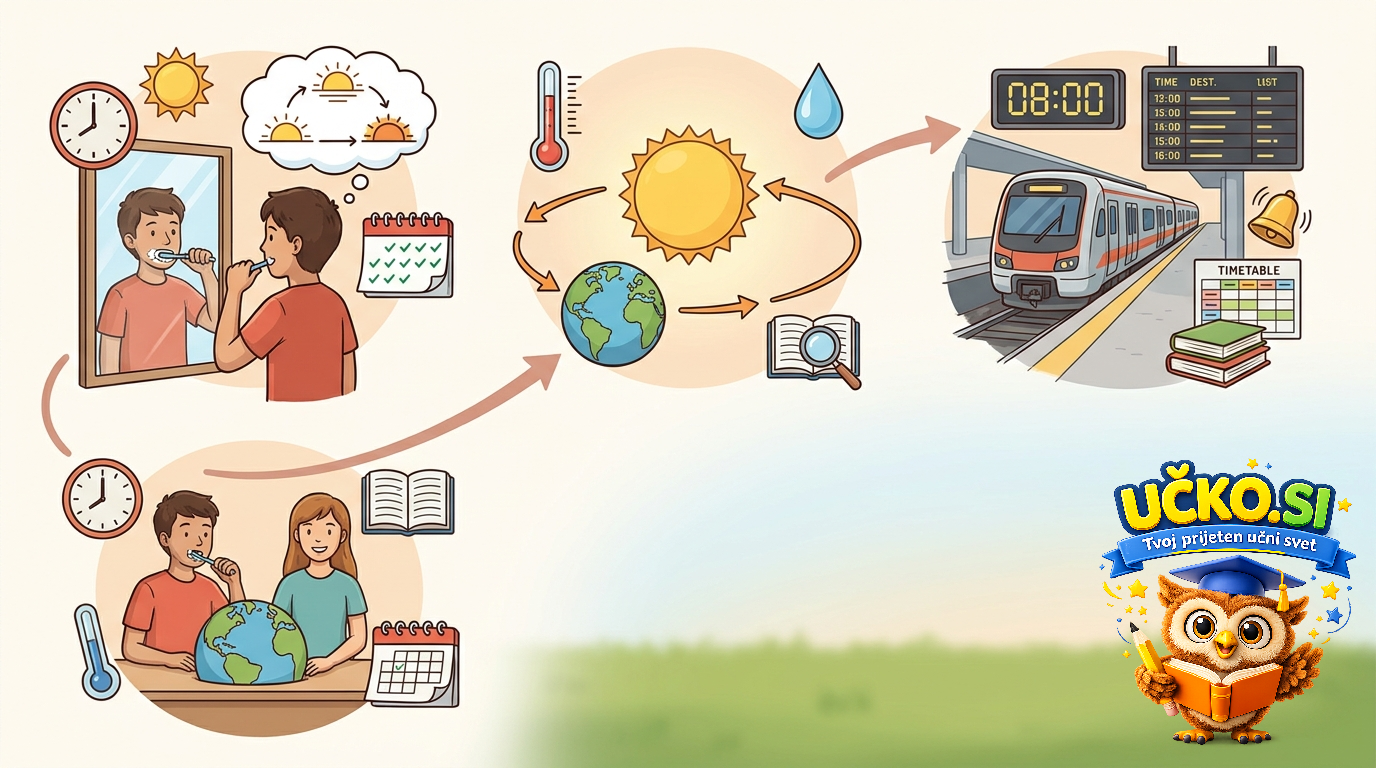
We use the Present Simple to talk about habits and routines, like what you do every day. It's also used for facts and general truths that are always true. Additionally, we use it for schedules and timetables, such as when a train leaves, and to give instructions.
- Habits and routines
- Facts and general truths
- Schedules and instructions
Forming Affirmative Sentences
For subjects I, You, We, They, use the base form of the verb (e.g., I eat). For He, She, It, add -s or -es to the verb (e.g., He eats). Remember the spelling rules for adding -s/-es, especially for verbs ending in -s, -ss, -sh, -ch, -x, -o, or consonant + -y.
- Base verb for I, You, We, They
- Add -s or -es for He, She, It
- Spelling rules for -s/-es endings
Making Negative Sentences and Questions
To make negative sentences, use 'don't' (do not) with I, You, We, They, and 'doesn't' (does not) with He, She, It, followed by the base form of the verb. For questions, start with 'Do' for I, You, We, They or 'Does' for He, She, It, then the subject and the base verb.
- Use 'don't' or 'doesn't' for negatives
- Use 'Do' or 'Does' to form questions
- The main verb stays in base form after 'don't/doesn't/Do/Does'
Zanimivosti
- The -s in 'does' for questions and negatives with He/She/It replaces the -s on the main verb.
- Time expressions like 'always' and 'every day' often signal the use of Present Simple.
Povzetek
The Present Simple describes habits, facts, schedules, and instructions. Form it by using the base verb or adding -s/-es, and use 'do/don't' and 'does/doesn't' for negatives and questions. Practice using it daily to improve your English.
Pogosta vprašanja
Kaj se naučimo pri temi Present simple?
The Present Simple is a very important tense in English. We use it for various situations, from daily habits to general truths. Understanding it well will help you communicate clearly.
Kaj je base form?
The original form of a verb without any endings.
Kaj je habits and routines?
Actions done regularly or repeatedly.
Kaj je -s/-es ending?
Suffix added to verbs for 'he, she, it' in Present Simple affirmative sentences.
Kako na kratko povzamemo temo Present simple?
The Present Simple describes habits, facts, schedules, and instructions. Form it by using the base verb or adding -s/-es, and use 'do/don't' and 'does/doesn't' for negatives and questions. Practice using it daily to improve your English.
Sorodne razlage – Angleščina, 9. razred
- Present simple and present continuous
- Present tenses
- Present tenses with future meaning
- Pronunciation and fluency
- Quantifiers and determiners
- Quantifiers: too, too much/many, (not) enough, a/an, some/any, much/many, a few, a lot of
- Question tags
- Questions and question forms
- Reacting to news
- Reading for gist/skimming
- Reading strategies
- Recognising contractions