Present simple and present continuous
Angleščina · 9. razred
Today, we'll learn about two important English tenses: Present Simple and Present Continuous. Knowing when to use each one will help you speak English more naturally and correctly.
Ključni pojmi
- Present Simple
- Tense for facts, habits, and scheduled events.
- Present Continuous
- Tense for actions happening now, temporary or developing situations.
- Stative Verbs
- Verbs describing states, rarely used in continuous tenses (e.g., love, know).
- Time Expressions
- Words that indicate when an action happens (e.g., 'every day', 'right now').
The Present Simple
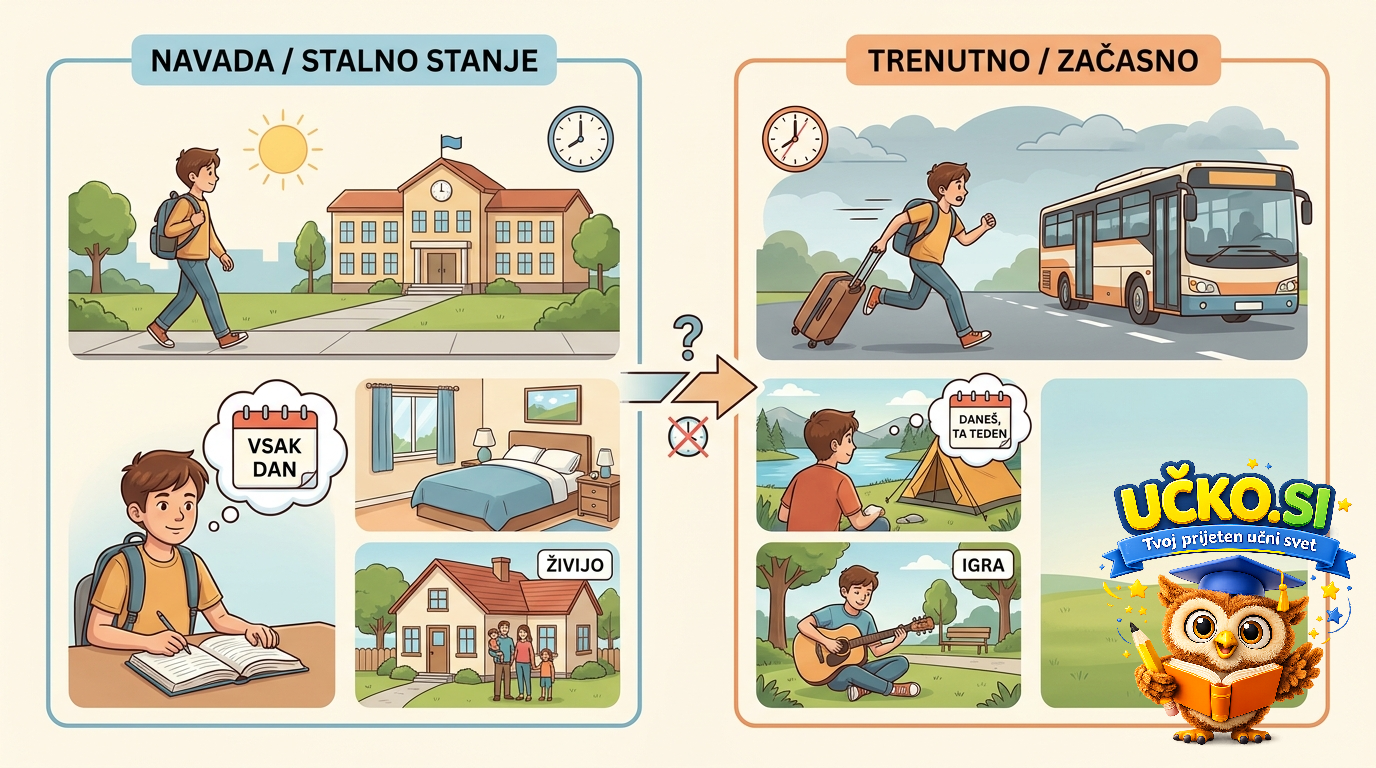
We use the Present Simple for general truths, habits, routines, and scheduled events. It describes actions that happen regularly or are facts. For most verbs, we use the base form, but for he/she/it, we add -s or -es. We use 'do not'/'does not' for negatives and 'Do'/'Does' for questions. Remember verbs like 'love' or 'know' (stative verbs) are rarely used in continuous tenses.
- Used for facts, habits, and schedules.
- Add -s/-es for he/she/it.
- Uses 'do/does' for negatives and questions.
The Present Continuous
The Present Continuous is for actions happening right now, temporary situations, and developing situations. It describes things you are doing at this exact moment or for a limited time. The form is 'am/is/are' + verb + '-ing'. For negatives, we add 'not' after 'am/is/are'. For questions, we start with 'Am/Is/Are'.
- Used for actions happening now or temporarily.
- Formed with 'am/is/are' + verb + '-ing'.
- Uses 'am/is/are' for negatives and questions.
Comparing the Tenses
The Present Simple describes regular actions or permanent states, like 'I usually walk to school' or 'He works in a bank.' The Present Continuous describes actions happening at the moment or for a temporary period, such as 'I am walking to school now' or 'He is working from home today.' Understanding this difference helps you choose the right tense for your sentences.
- Present Simple: regular actions, permanent states.
- Present Continuous: actions happening now, temporary situations.
Zanimivosti
- The sun rises in the east.
- Water boils at 100 degrees Celsius.
- Your English is improving.
Povzetek
The Present Simple describes facts, habits, and schedules, using base verbs and -s/-es for third person singular. The Present Continuous describes actions happening now or temporarily, using 'am/is/are' + verb + '-ing'. Knowing when to use each tense will make your English more accurate.
Pogosta vprašanja
Kaj se naučimo pri temi Present simple and present continuous?
Today, we'll learn about two important English tenses: Present Simple and Present Continuous. Knowing when to use each one will help you speak English more naturally and correctly.
Kaj je present simple?
Tense for facts, habits, and scheduled events.
Kaj je present continuous?
Tense for actions happening now, temporary or developing situations.
Kaj je stative verbs?
Verbs describing states, rarely used in continuous tenses (e.g., love, know).
Kako na kratko povzamemo temo Present simple and present continuous?
The Present Simple describes facts, habits, and schedules, using base verbs and -s/-es for third person singular. The Present Continuous describes actions happening now or temporarily, using 'am/is/are' + verb + '-ing'. Knowing when to use each tense will make your English more accurate.
Kje najdem vaje in vprašanja za temo Present simple and present continuous?
Za temo Present simple and present continuous (Angleščina, 9. razred) so v aplikaciji Učko.si kviz z vprašanji in odgovori ter vaje za preverjanje znanja.
Sorodne razlage – Angleščina, 9. razred
- Present tenses
- Present tenses with future meaning
- Pronunciation and fluency
- Quantifiers and determiners
- Quantifiers: too, too much/many, (not) enough, a/an, some/any, much/many, a few, a lot of
- Question tags
- Questions and question forms
- Reacting to news
- Reading for gist/skimming
- Reading strategies
- Recognising contractions
- Recognising informal speech