Present perfect and past simple
Angleščina · 9. razred
Today, we're learning about two important English tenses: the Present Perfect and the Past Simple. These tenses help us talk about actions that happened at different times. Understanding when to use each one is key!
Ključni pojmi
- Past Simple
- Describes actions completed in the past.
- Present Perfect
- Describes actions connected to the present or unspecified past actions.
- Past Participle
- The third form of a verb, used with 'have'/'has' for Present Perfect.
- Keywords
- Words that often indicate which tense to use.
Past Simple: Finished Actions in the Past
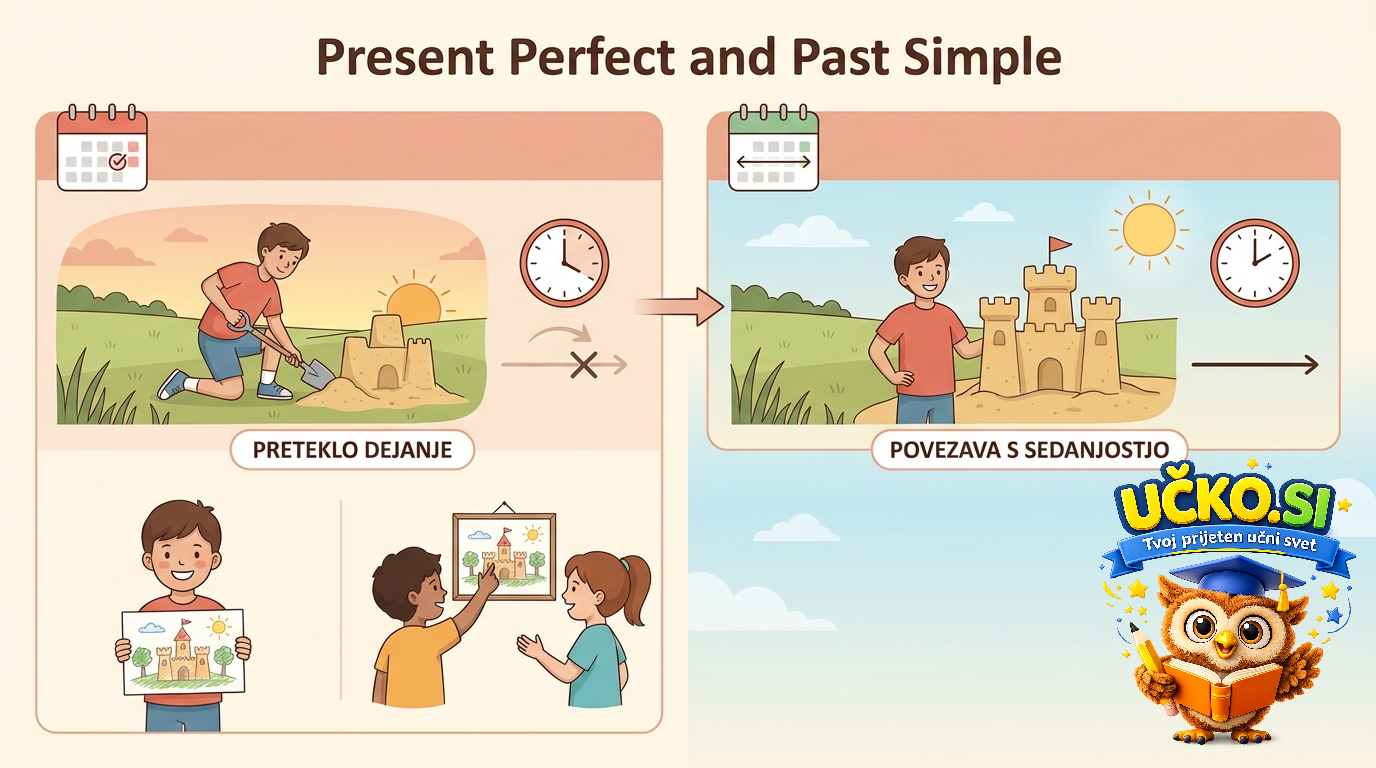
We use the Past Simple for actions that started and finished in the past. We usually know exactly when these actions happened. For regular verbs, we add '-ed' to the base form, but irregular verbs have special forms you need to learn. This tense describes completed actions.
- Used for actions completed in the past.
- Exact time of action is usually known (e.g., 'yesterday', 'last week').
Present Perfect: Past Actions with Present Connection
The Present Perfect is used for actions that started in the past and continue to now, or for actions that happened at an unknown time in the past where the result is important. It's also used for very recent actions. We form it with 'have' or 'has' plus the past participle (the third form) of the verb.
- Used for actions continuing to the present or with a present result.
- Time of action is often unspecified or very recent.
Key Difference: Time Focus
The main difference between these two tenses is about when the time of the action finishes. With the Past Simple, the time is finished, like 'yesterday' or 'last year'. With the Present Perfect, the time is not finished, such as 'today' or 'this week', or the exact time isn't important.
- Past Simple: Time of action is finished.
- Present Perfect: Time of action is not finished or unspecified.
Zanimivosti
- Regular verbs in Past Simple add '-ed' (e.g., 'play' -> 'played').
- Irregular verbs have unique Past Simple and Past Participle forms (e.g., 'go' -> 'went' -> 'gone').
Povzetek
The Past Simple is for completed past actions with a definite time. The Present Perfect is for actions connected to the present or for experiences without a specific past time. Remember to focus on whether the time of the action is finished or not.
Pogosta vprašanja
Kaj se naučimo pri temi Present perfect and past simple?
Today, we're learning about two important English tenses: the Present Perfect and the Past Simple. These tenses help us talk about actions that happened at different times. Understanding when to use each one is key!
Kaj je past simple?
Describes actions completed in the past.
Kaj je present perfect?
Describes actions connected to the present or unspecified past actions.
Kaj je past participle?
The third form of a verb, used with 'have'/'has' for Present Perfect.
Kako na kratko povzamemo temo Present perfect and past simple?
The Past Simple is for completed past actions with a definite time. The Present Perfect is for actions connected to the present or for experiences without a specific past time. Remember to focus on whether the time of the action is finished or not.
Sorodne razlage – Angleščina, 9. razred
- Present perfect with for and since
- Present simple
- Present simple and present continuous
- Present tenses
- Present tenses with future meaning
- Pronunciation and fluency
- Quantifiers and determiners
- Quantifiers: too, too much/many, (not) enough, a/an, some/any, much/many, a few, a lot of
- Question tags
- Questions and question forms
- Reacting to news
- Reading for gist/skimming