Present continuous
Angleščina · 9. razred
The Present Continuous tense helps us talk about actions happening right now or around this time. It's a very useful tense you will use often in English. Let's learn how to form it and when to use it!
Ključni pojmi
- Present Continuous
- Describes actions happening at the moment of speaking or around now.
- Verb-ing
- The base verb with '-ing' added.
- Temporary situations
- Actions that are in progress for a limited time.
- Future plans
- Definite arrangements or events scheduled for the future.
Forming the Present Continuous
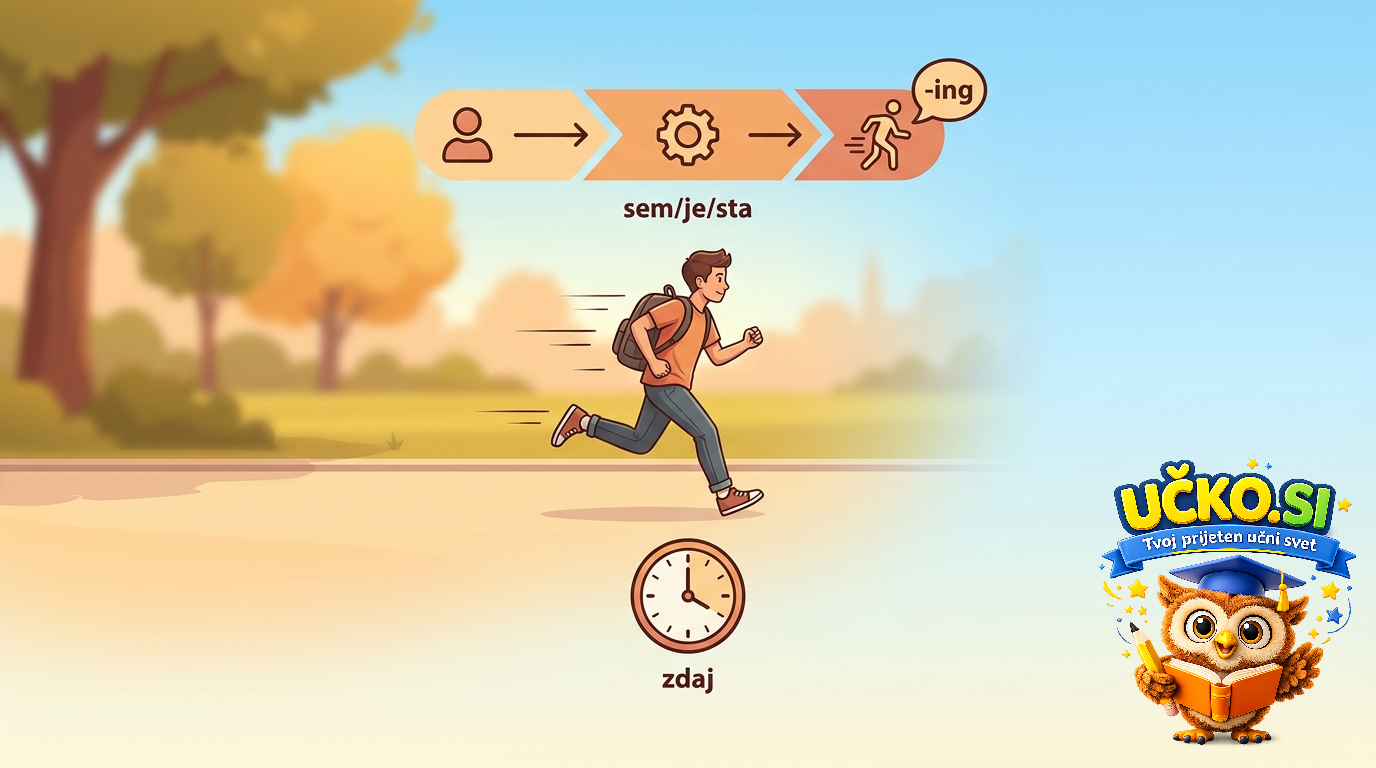
To form the Present Continuous, we use two parts: the present tense of 'to be' (am, is, are) and the main verb with '-ing'. The structure is Subject + am/is/are + verb-ing. For example, 'I am reading a book' or 'They are talking on the phone.'
- Uses 'am, is, are' + verb-ing
- Subject + am/is/are + verb-ing
Spelling Rules for -ing
Most verbs simply add '-ing', like 'play' becoming 'playing'. If a verb ends in '-e', drop the '-e' before adding '-ing', such as 'make' becoming 'making'. For short verbs ending in consonant + vowel + consonant (CVC), double the last consonant before adding '-ing', like 'run' becoming 'running'.
- Most verbs add -ing
- Verbs ending in -e: drop -e, add -ing
- CVC verbs: double last consonant, add -ing
When to Use the Present Continuous
We use the Present Continuous for actions happening now, like 'The cat is sleeping.' It also describes actions happening around now, such as 'She is working on a new project this month.' This tense is also used for temporary situations, like 'I am staying with my aunt this week,' and for future plans, like 'We are meeting our friends tomorrow.'
- Actions happening NOW
- Actions happening around NOW
- Temporary situations and future plans
Negative and Question Forms
To make a negative sentence, add 'not' after 'am/is/are', for example, 'I am not watching TV.' To ask a question, put 'am/is/are' before the subject, such as 'Are you studying?' Time expressions like 'now' and 'at the moment' are often used with this tense.
- Negative: Subject + am/is/are + not + verb-ing
- Question: Am/Is/Are + Subject + verb-ing?
Zanimivosti
- The Present Continuous is sometimes called Present Progressive.
- It's all about actions in progress!
Povzetek
The Present Continuous describes actions happening now or around now. It's formed with 'to be' + verb-ing and has specific spelling rules. You can use it for temporary situations and future plans, and it has clear negative and question forms.
Pogosta vprašanja
Kaj se naučimo pri temi Present continuous?
The Present Continuous tense helps us talk about actions happening right now or around this time. It's a very useful tense you will use often in English. Let's learn how to form it and when to use it!
Kaj je present continuous?
Describes actions happening at the moment of speaking or around now.
Kaj je verb-ing?
The base verb with '-ing' added.
Kaj je temporary situations?
Actions that are in progress for a limited time.
Kako na kratko povzamemo temo Present continuous?
The Present Continuous describes actions happening now or around now. It's formed with 'to be' + verb-ing and has specific spelling rules. You can use it for temporary situations and future plans, and it has clear negative and question forms.
Sorodne razlage – Angleščina, 9. razred
- Present perfect
- Present perfect and past simple
- Present perfect with for and since
- Present simple
- Present simple and present continuous
- Present tenses
- Present tenses with future meaning
- Pronunciation and fluency
- Quantifiers and determiners
- Quantifiers: too, too much/many, (not) enough, a/an, some/any, much/many, a few, a lot of
- Question tags
- Questions and question forms