Past simple
Angleščina · 9. razred
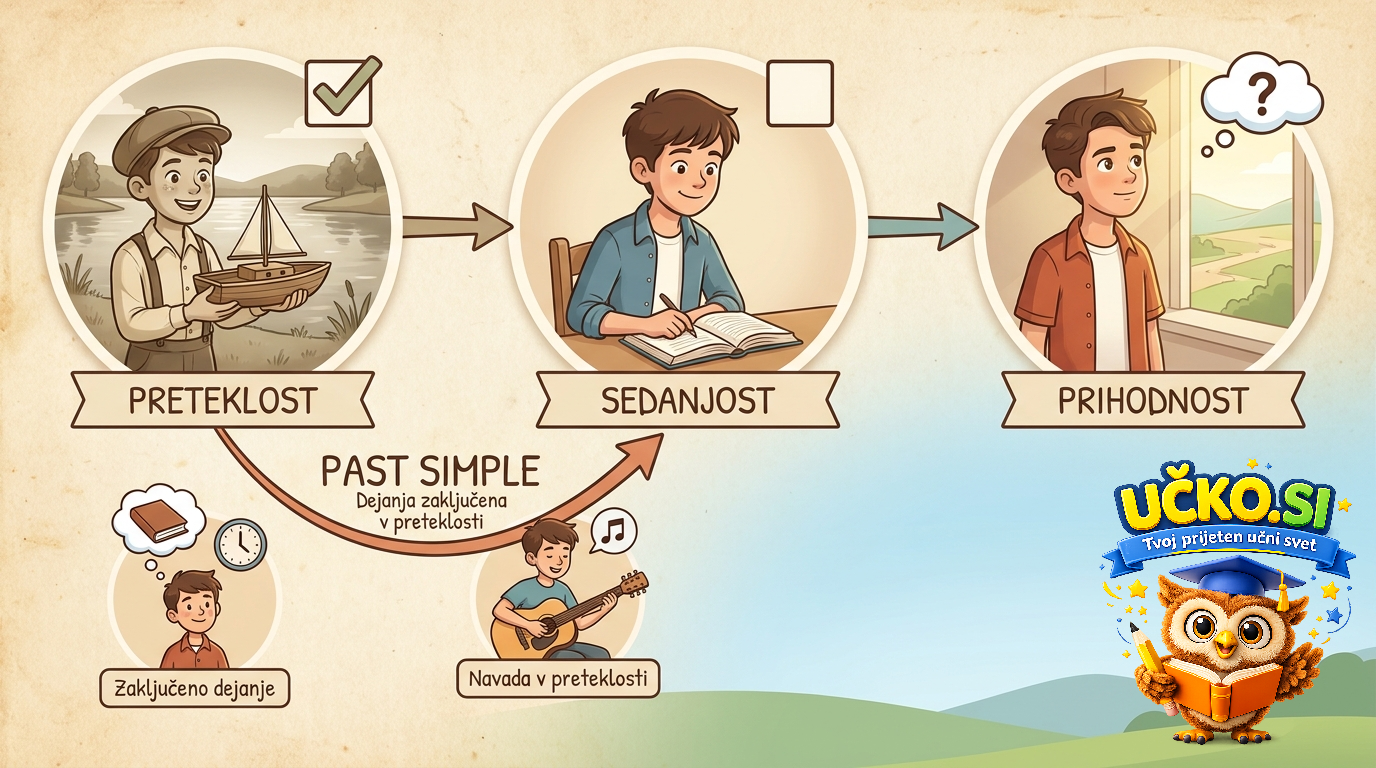
Hello, Grade 9 students! Today we're learning about the Past Simple tense. We use it to talk about actions or events that started and finished in the past.
Ključni pojmi
- Past Simple
- Describes actions or events that started and finished in the past.
- Regular Verbs
- Verbs that form the Past Simple by adding '-ed'.
- Irregular Verbs
- Verbs that do not follow the '-ed' rule and have special Past Simple forms.
- Did not (didn't)
- Used to form negative sentences in the Past Simple.
- Was/Were
- The Past Simple forms of the verb 'to be'.
What is the Past Simple?
The Past Simple describes actions or events that are already over. We often know exactly when they happened, using words like 'yesterday' or 'last week'. It's like telling a story about something that is complete.
- Describes finished actions.
- Often used with specific time expressions.
Regular and Irregular Verbs
To form the Past Simple, regular verbs usually add '-ed' to their base form, like 'walk' becoming 'walked'. Irregular verbs, however, have special forms that you need to learn, for example, 'go' changes to 'went'.
- Regular verbs add '-ed'.
- Irregular verbs have unique forms.
Forming Sentences
For positive sentences, we use the subject and the verb in its Past Simple form. For negative sentences, we use 'did not' (didn't) and the base form of the verb. To ask a question, we start with 'Did', then the subject, and the base form of the verb.
- Affirmative: Subject + Past Simple verb.
- Negative: Subject + didn't + base verb.
- Questions: Did + Subject + base verb?
The Verb 'To Be'
The verb 'to be' is special in the Past Simple. For 'I', 'he', 'she', 'it', we use 'was'. For 'you', 'we', 'they', we use 'were'. This verb also changes its form for negatives and questions without 'did'.
- Use 'was' for singular subjects (I, he, she, it).
- Use 'were' for plural subjects (you, we, they).
Zanimivosti
- The 'did' in negative sentences and questions tells us it's past, so the main verb goes back to its original form.
- The verb 'to be' is irregular and behaves differently from other verbs in the Past Simple.
Povzetek
The Past Simple tense is used for finished actions in the past. Regular verbs add '-ed', while irregular verbs have unique forms. Remember 'did' for negatives and questions, and 'was/were' for the verb 'to be'.
Pogosta vprašanja
Kaj se naučimo pri temi Past simple?
Hello, Grade 9 students! Today we're learning about the Past Simple tense. We use it to talk about actions or events that started and finished in the past.
Kaj je past simple?
Describes actions or events that started and finished in the past.
Kaj je regular verbs?
Verbs that form the Past Simple by adding '-ed'.
Kaj je irregular verbs?
Verbs that do not follow the '-ed' rule and have special Past Simple forms.
Kako na kratko povzamemo temo Past simple?
The Past Simple tense is used for finished actions in the past. Regular verbs add '-ed', while irregular verbs have unique forms. Remember 'did' for negatives and questions, and 'was/were' for the verb 'to be'.
Sorodne razlage – Angleščina, 9. razred
- Predicting what you will hear
- Present continuous
- Present perfect
- Present perfect and past simple
- Present perfect with for and since
- Present simple
- Present simple and present continuous
- Present tenses
- Present tenses with future meaning
- Pronunciation and fluency
- Quantifiers and determiners
- Quantifiers: too, too much/many, (not) enough, a/an, some/any, much/many, a few, a lot of