Past perfect
Angleščina · 9. razred
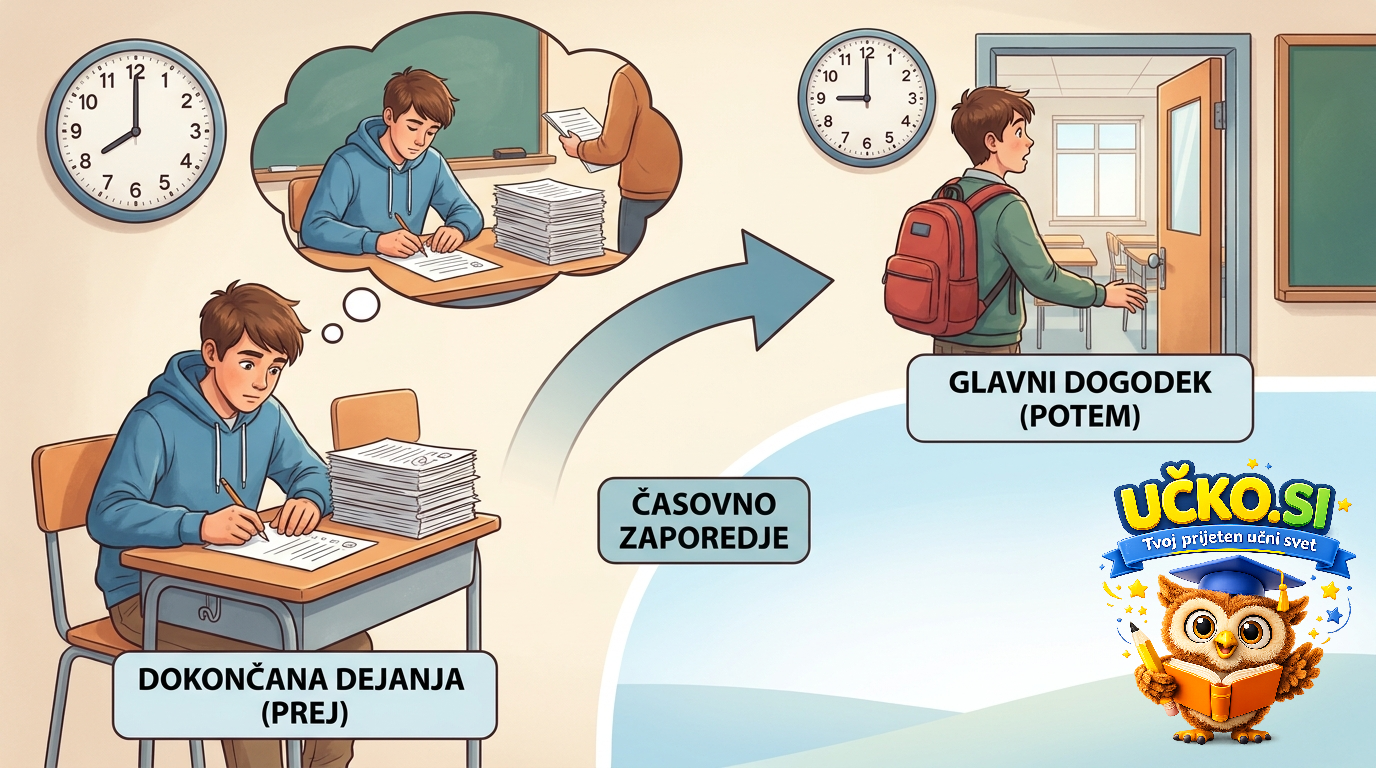
The Past Perfect helps us talk about actions that happened even earlier than another past event. It describes the action that happened FIRST when you have two past events. Don't worry, it's simpler than it sounds!
Ključni pojmi
- Past Perfect
- Describes an action that happened before another past event.
- Past Participle
- The form of a verb used with 'had' for the Past Perfect (e.g., finished, seen).
- Had
- Auxiliary verb used to form the Past Perfect.
- Before
- A word often used to indicate the earlier action with Past Perfect.
How to Form the Past Perfect
To form the Past Perfect, you always use 'had' followed by the past participle of the main verb. For regular verbs, this is usually verb + -ed, like 'played'. For irregular verbs, you need to remember their special form, such as 'seen' or 'eaten'. The structure is: Subject + had + past participle.
- Use 'had' + past participle.
- Regular verbs: verb + -ed.
When to Use the Past Perfect
We use the Past Perfect mainly in two situations. First, to show one action happened BEFORE another action in the past, often with words like 'before' or 'when'. Second, to talk about an action completed before a specific time in the past, like 'By 2010'. This tense is almost always used with another past tense, usually the Simple Past, to show the order of events.
- Action happened before another past action.
- Action happened before a specific past time.
Negative Sentences and Questions
To make negative sentences, simply add 'not' after 'had' (hadn't). For example, 'I hadn't seen him before'. To ask questions, put 'had' before the subject, like 'Had you ever flown on an airplane?'.
- Negatives: Subject + had + not + past participle.
- Questions: Had + subject + past participle?
Zanimivosti
- The Past Perfect helps explain the order of events in the past.
- It is very helpful for telling stories.
Povzetek
The Past Perfect describes an action completed before another past action or time. You form it with 'had' and the past participle. It helps clarify the sequence of events in past stories.
Pogosta vprašanja
Kaj se naučimo pri temi Past perfect?
The Past Perfect helps us talk about actions that happened even earlier than another past event. It describes the action that happened FIRST when you have two past events. Don't worry, it's simpler than it sounds!
Kaj je past perfect?
Describes an action that happened before another past event.
Kaj je past participle?
The form of a verb used with 'had' for the Past Perfect (e.g., finished, seen).
Kaj je had?
Auxiliary verb used to form the Past Perfect.
Kako na kratko povzamemo temo Past perfect?
The Past Perfect describes an action completed before another past action or time. You form it with 'had' and the past participle. It helps clarify the sequence of events in past stories.
Sorodne razlage – Angleščina, 9. razred
- Past simple
- Predicting what you will hear
- Present continuous
- Present perfect
- Present perfect and past simple
- Present perfect with for and since
- Present simple
- Present simple and present continuous
- Present tenses
- Present tenses with future meaning
- Pronunciation and fluency
- Quantifiers and determiners