Going to
Angleščina · 9. razred
Today, we'll learn about "going to," a useful way to talk about the future in English. We use it for plans and predictions. It helps us express things we've already decided or expect to happen.
Ključni pojmi
- Plans
- Načrti
- Intentions
- Namere
- Predictions
- Napovedi
- Evidence
- Dokazi
- Spontaneous
- Spontano
Future Plans and Intentions
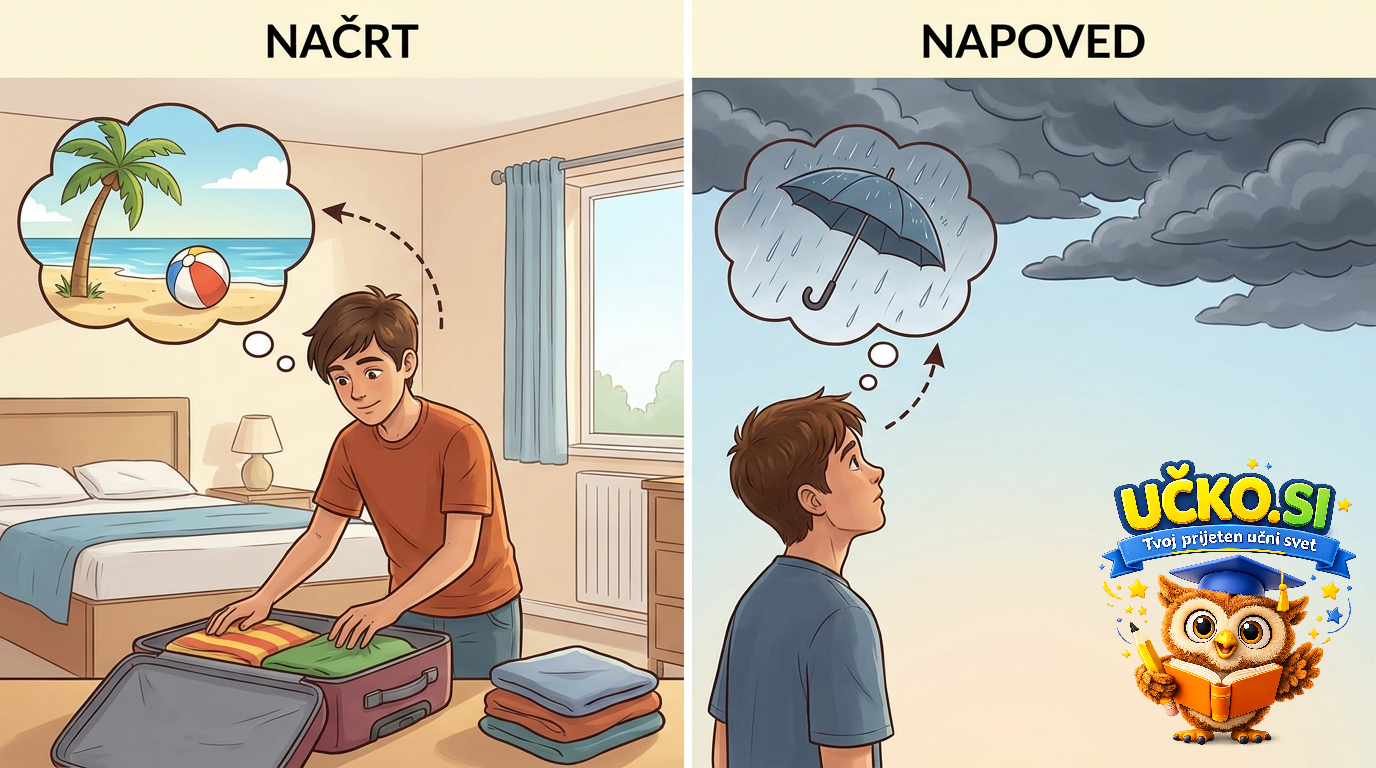
We use "going to" for plans and intentions we've already made. It's for decisions you've thought about, not spontaneous ones. For example, "I am going to visit my grandparents next weekend" shows a made plan. Another example is, "She is going to study for her English test tonight," which is her clear intention.
- Used for decided plans.
- Used for intentions.
Predictions Based on Evidence
"Going to" is also used for predictions when there's clear evidence now. You see something happening that tells you what will occur. For instance, "Look at those dark clouds! It's going to rain" uses the clouds as evidence. Similarly, "He's driving too fast. He's going to have an accident" uses his driving as evidence.
- Used for predictions.
- Requires present evidence.
Grammar Rules: Structure and Usage
The basic structure is Subject + Verb "to be" (am/is/are) + going to + Base Form of the Verb. For negative sentences, add "not" after the verb "to be." To form a question, put the verb "to be" before the subject. Short answers use "Yes, I am" or "No, I'm not" forms.
- Structure: Subject + be + going to + Verb.
- Negative: Add 'not' after 'be'.
- Questions: 'Be' before Subject.
Zanimivosti
- "Going to" is for things you've already decided.
- It can be used to describe what will happen based on what you see now.
Povzetek
"Going to" helps us talk about future plans and intentions that are already made. It also allows us to make predictions based on current evidence. Remember its simple structure to use it correctly in sentences, questions, and negatives.
Pogosta vprašanja
Kaj se naučimo pri temi Going to?
Today, we'll learn about "going to," a useful way to talk about the future in English. We use it for plans and predictions. It helps us express things we've already decided or expect to happen.
Kaj je plans?
Načrti
Kaj je intentions?
Namere
Kaj je predictions?
Napovedi
Kako na kratko povzamemo temo Going to?
"Going to" helps us talk about future plans and intentions that are already made. It also allows us to make predictions based on current evidence. Remember its simple structure to use it correctly in sentences, questions, and negatives.
Sorodne razlage – Angleščina, 9. razred
- Guessing meaning from context
- Health and well-being
- Identifying facts and opinions
- Identifying text purpose
- Indirect and reported speech
- Intonation in reported speech
- IT and technology
- Jobs in science
- Just, yet and already
- Listening for specific information
- Listening for the information you need
- Listening skills