Guessing meaning from context
Angleščina · 9. razred
Hello, future English speakers! Today we're learning a super useful skill: guessing meaning from context. This means figuring out what new words mean by looking at the words and sentences around them. It's important because you won't always have a dictionary, and it helps you keep reading without stopping.
Ključni pojmi
- Context
- The words and sentences around an unknown word.
- Synonym
- A word that means the same as another word.
- Antonym
- A word that means the opposite of another word.
- Dilapidated
- Old and falling apart.
- Famished
- Extremely hungry.
How to Find Clues
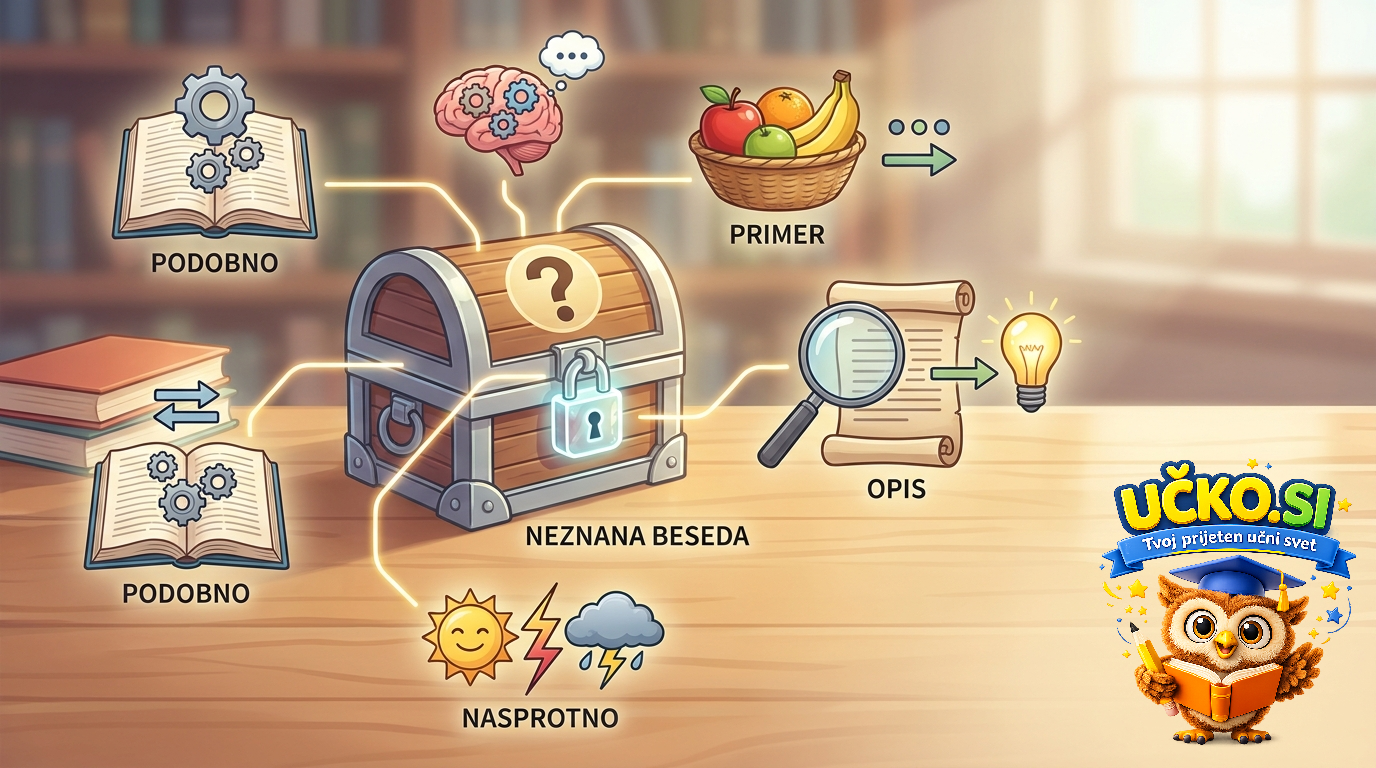
To guess a word's meaning, first look closely at the sentence it's in. Sometimes, other words in the same sentence will explain the unknown word. If not, check the sentences before or after for more clues. These surrounding sentences can give you hints about the word's meaning.
- Look for clues within the same sentence.
- Check surrounding sentences for additional information.
Using Synonyms, Antonyms, and Definitions
The text might give you words that mean the same (synonyms) or the opposite (antonyms) as the unknown word. For example, if a text says someone is 'amiable' and then describes them as 'friendly,' 'friendly' is a synonym. Sometimes, the text will even define the word directly, often using phrases like 'which means' or commas.
- Identify synonyms (same meaning) or antonyms (opposite meaning).
- Look for direct definitions or explanations in the text.
Considering Word Type and Examples
Think about what type of word it is: a noun, verb, or adjective. This helps you understand its role in the sentence. For instance, an '-ly' ending often means it's an adverb, describing how something is done. Examples given in the text, like 'bright red, sunny yellow, and electric blue' for 'vibrant,' can also clearly show you what a word means.
- Identify the word type (noun, verb, adjective) to understand its function.
- Use examples provided in the text to clarify meaning.
Zanimivosti
- Guessing from context helps you understand general meaning and keep reading.
- The '-ly' ending often indicates an adverb.
Povzetek
Guessing meaning from context is a vital skill for English learners. By using clues from sentences, synonyms, antonyms, and word types, you can understand new words without a dictionary. This helps you follow stories and information more easily.
Pogosta vprašanja
Kaj se naučimo pri temi Guessing meaning from context?
Hello, future English speakers! Today we're learning a super useful skill: guessing meaning from context. This means figuring out what new words mean by looking at the words and sentences around them. It's important because you won't always have a dictionary, and it helps you keep reading without stopping.
Kaj je context?
The words and sentences around an unknown word.
Kaj je synonym?
A word that means the same as another word.
Kaj je antonym?
A word that means the opposite of another word.
Kako na kratko povzamemo temo Guessing meaning from context?
Guessing meaning from context is a vital skill for English learners. By using clues from sentences, synonyms, antonyms, and word types, you can understand new words without a dictionary. This helps you follow stories and information more easily.
Kje najdem vaje in vprašanja za temo Guessing meaning from context?
Za temo Guessing meaning from context (Angleščina, 9. razred) so v aplikaciji Učko.si kviz z vprašanji in odgovori ter vaje za preverjanje znanja.
Sorodne razlage – Angleščina, 9. razred
- Health and well-being
- Identifying facts and opinions
- Identifying text purpose
- Indirect and reported speech
- Intonation in reported speech
- IT and technology
- Jobs in science
- Just, yet and already
- Listening for specific information
- Listening for the information you need
- Listening skills
- Modal verbs