Future tenses: review
Angleščina · 9. razred
Hey, Grade 9! Let's quickly review how we talk about the future in English. We use different tenses depending on what we want to say. This lesson will help you remember the main ones.
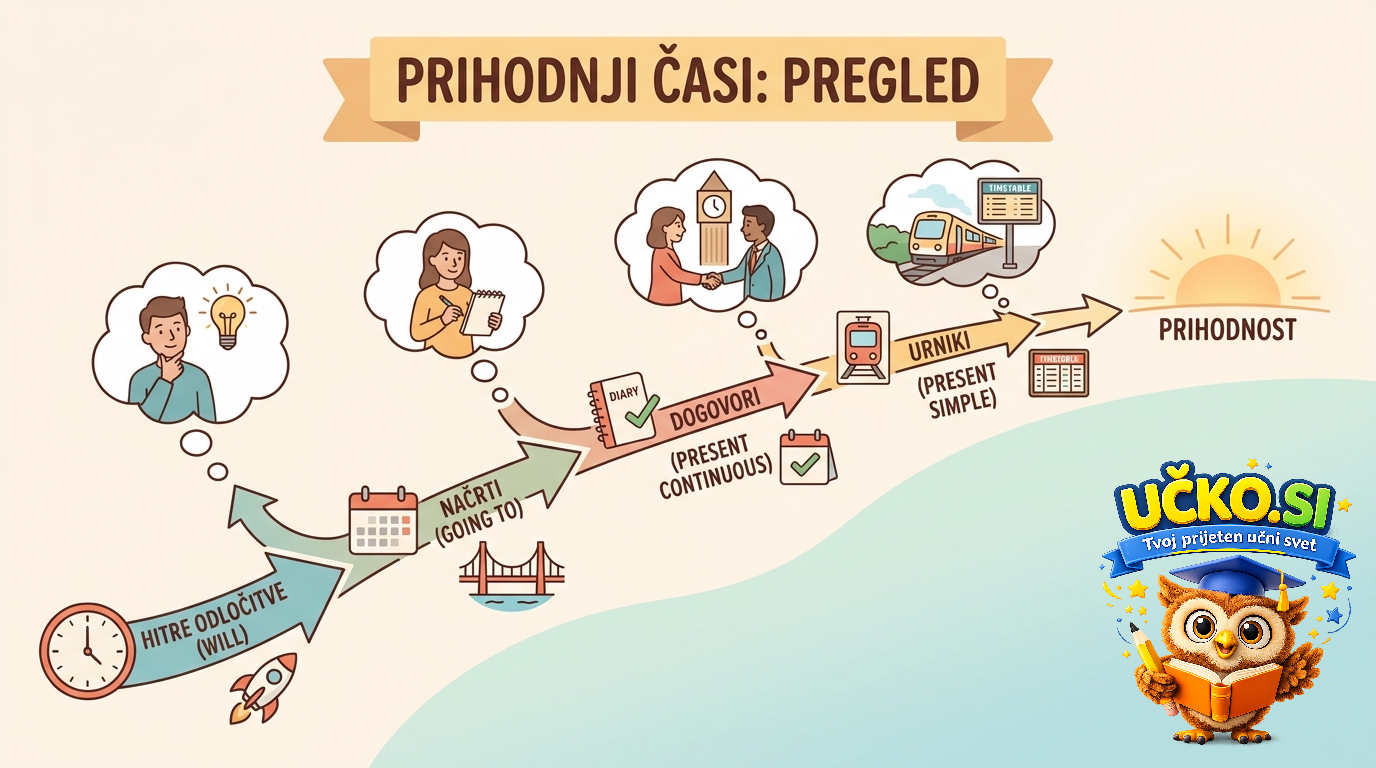
Ključni pojmi
- Will
- Used for predictions, spontaneous decisions, promises, and offers.
- Be going to
- Used for plans/intentions and predictions based on present evidence.
- Present Continuous
- Used for definite arrangements in the near future.
- Present Simple
- Used for timetables, schedules, and programs.
Will and Be Going To
We use 'will' for predictions, spontaneous decisions, promises, and offers. For example, 'I think it will rain tomorrow' or 'I'll help you.' 'Be going to' is for plans you've already made, like 'We are going to visit grandparents,' or for predictions based on what you see now, such as 'It's going to storm.'
- Will: predictions, spontaneous decisions, promises, offers.
- Be going to: plans/intentions, predictions based on evidence.
Present Continuous and Present Simple
The Present Continuous is for definite arrangements in the near future, often with a specific time. Think of things you've confirmed, like 'I am meeting my friend at 7 PM.' The Present Simple is used for timetables, schedules, and programs. For instance, 'The train leaves at 8 AM' or 'The film starts at 9 PM.'
- Present Continuous: definite arrangements (fixed plans).
- Present Simple: timetables, schedules, programs (fixed events).
Zanimivosti
- You can use 'won't' as a short form for 'will not'.
- Present Continuous for future often includes a specific time or date.
Povzetek
English uses different tenses like 'will,' 'be going to,' Present Continuous, and Present Simple to talk about the future. Each tense has specific situations where it's best to use it. Knowing these helps you express future events clearly.
Pogosta vprašanja
Kaj se naučimo pri temi Future tenses: review?
Hey, Grade 9! Let's quickly review how we talk about the future in English. We use different tenses depending on what we want to say. This lesson will help you remember the main ones.
Kaj je will?
Used for predictions, spontaneous decisions, promises, and offers.
Kaj je be going to?
Used for plans/intentions and predictions based on present evidence.
Kaj je present continuous?
Used for definite arrangements in the near future.
Kako na kratko povzamemo temo Future tenses: review?
English uses different tenses like 'will,' 'be going to,' Present Continuous, and Present Simple to talk about the future. Each tense has specific situations where it's best to use it. Knowing these helps you express future events clearly.
Sorodne razlage – Angleščina, 9. razred
- Gerund and infinitive
- Gerunds and infinitives
- Giving advice
- Giving an opinion
- Giving instructions
- Going to
- Guessing meaning from context
- Health and well-being
- Identifying facts and opinions
- Identifying text purpose
- Indirect and reported speech
- Intonation in reported speech