plural forms of nouns
Angleščina · 6. razred
Hello everyone! Today we will learn how to make nouns plural in English. 'Plural' means there is more than one of something. A 'noun' is a word for a person, place, animal, or thing.
Ključni pojmi
- Plural
- More than one.
- Noun
- A word for a person, place, animal, or thing.
- Consonant
- Not a vowel (a, e, i, o, u).
- Vowel
- Letters a, e, i, o, u.
- Irregular Plurals
- Nouns with special plural forms that don't follow rules.
Regular Plurals: Adding -s and -es
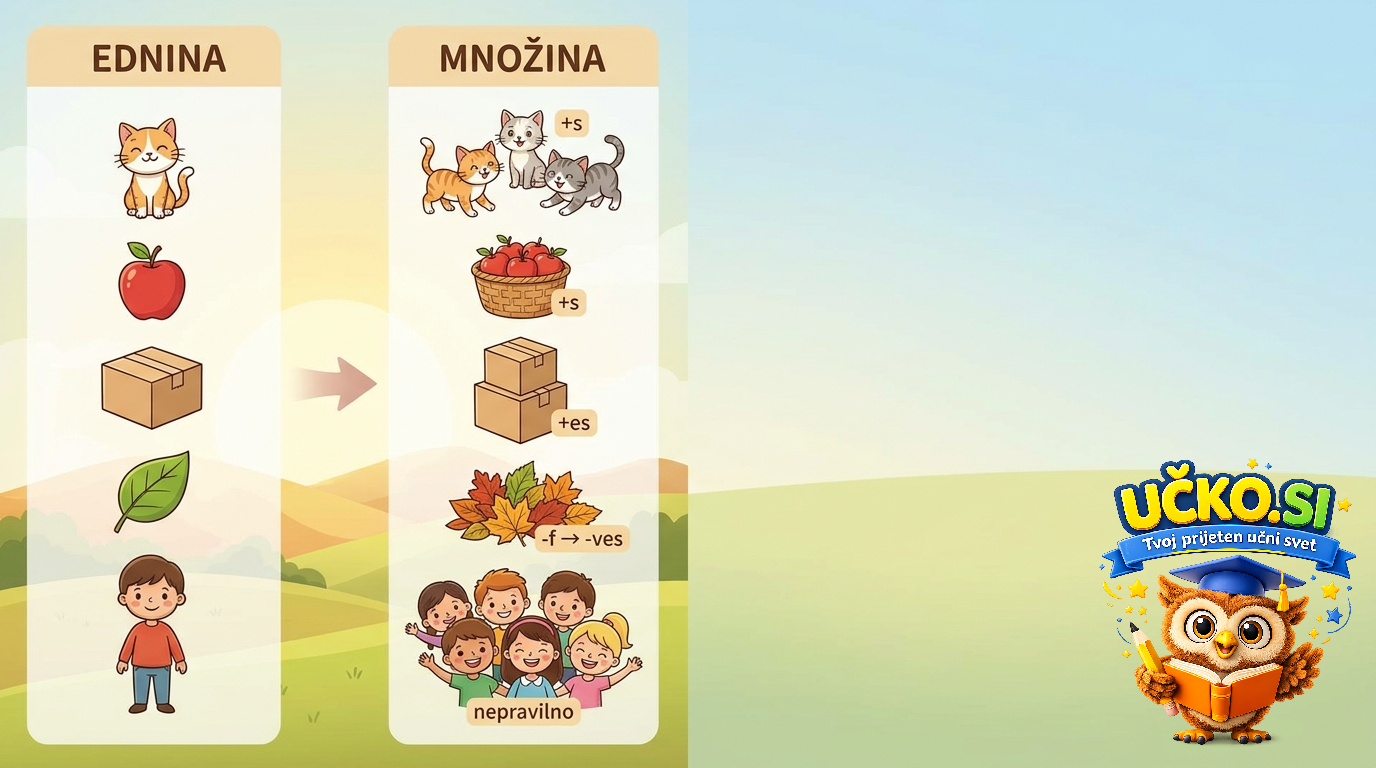
Most nouns become plural by simply adding -s to the end, like 'cat' becomes 'cats'. If a noun ends with -s, -ss, -sh, -ch, -x, or -z, we add -es to make it plural, for example, 'bus' becomes 'buses'. This rule helps make words easier to say when they are plural.
- Add -s to most nouns (e.g., dog -> dogs).
- Add -es to nouns ending in -s, -ss, -sh, -ch, -x, -z (e.g., box -> boxes).
Nouns Ending in -y and -f/-fe
When a noun ends with a consonant plus -y, change the -y to -i and add -es, like 'baby' becomes 'babies'. However, if a noun ends with a vowel plus -y, just add -s, for example, 'toy' becomes 'toys'. For some nouns ending in -f or -fe, we change the -f or -fe to -ves, so 'leaf' becomes 'leaves'.
- Consonant + -y: change -y to -ies (e.g., city -> cities).
- Vowel + -y: just add -s (e.g., boy -> boys).
- -f or -fe: change to -ves (e.g., knife -> knives).
Irregular Plurals
Some nouns have special plural forms that don't follow any rules; you need to learn these by heart. Examples include 'man' becoming 'men' and 'child' becoming 'children'. Also, some nouns have the same form for both singular and plural, such as 'sheep' and 'fish'.
- Some nouns change completely (e.g., man -> men, child -> children).
- Some nouns stay the same for singular and plural (e.g., sheep, fish).
Zanimivosti
- The word 'plural' means 'more than one'.
- Adding -es to some nouns makes them easier to say.
- You need to learn irregular plural nouns by heart.
Povzetek
We learned different ways to form plural nouns in English. Most nouns add -s, but some add -es, change -y to -ies, or -f/-fe to -ves. Remember that irregular plurals have special forms or stay the same.
Pogosta vprašanja
Kaj se naučimo pri temi plural forms of nouns?
Hello everyone! Today we will learn how to make nouns plural in English. 'Plural' means there is more than one of something. A 'noun' is a word for a person, place, animal, or thing.
Kaj je plural?
More than one.
Kaj je noun?
A word for a person, place, animal, or thing.
Kaj je consonant?
Not a vowel (a, e, i, o, u).
Kako na kratko povzamemo temo plural forms of nouns?
We learned different ways to form plural nouns in English. Most nouns add -s, but some add -es, change -y to -ies, or -f/-fe to -ves. Remember that irregular plurals have special forms or stay the same.
Kje najdem vaje in vprašanja za temo plural forms of nouns?
Za temo plural forms of nouns (Angleščina, 6. razred) so v aplikaciji Učko.si kviz z vprašanji in odgovori ter vaje za preverjanje znanja.
Sorodne razlage – Angleščina, 6. razred
- possessive 's
- possessive adjectives
- possessive pronouns
- prepositions used to describe position (in, on, under, next to)
- present continuous – affirmative form
- present continuous – negative form
- present continuous – questions
- present simple – affirmative form
- present simple – negative form
- present simple – wh questions
- present simple – yes/no questions
- questions and short answers with have got