present simple – affirmative form
Angleščina · 6. razred
Hello, future English speakers! Today we learn about the Present Simple. We use it to talk about things that are always true, happen regularly, or are facts. We will focus on making positive sentences, called the affirmative form.
Ključni pojmi
- Affirmative
- Meaning 'yes' or positive sentences.
- Base form
- The verb without 'to' (e.g., walk, play).
- Adverbs of frequency
- Words like 'always,' 'often,' 'usually' that show how often something happens.
When to Use the Present Simple
The Present Simple is used for regular actions that you do often, like every day or every week. It's also for facts and general truths, things that are always true. Finally, we use it for habits, things you do out of habit.
- Regular Actions: Things you do often.
- Facts and General Truths: Things that are always true.
- Habits: Things you do out of habit.
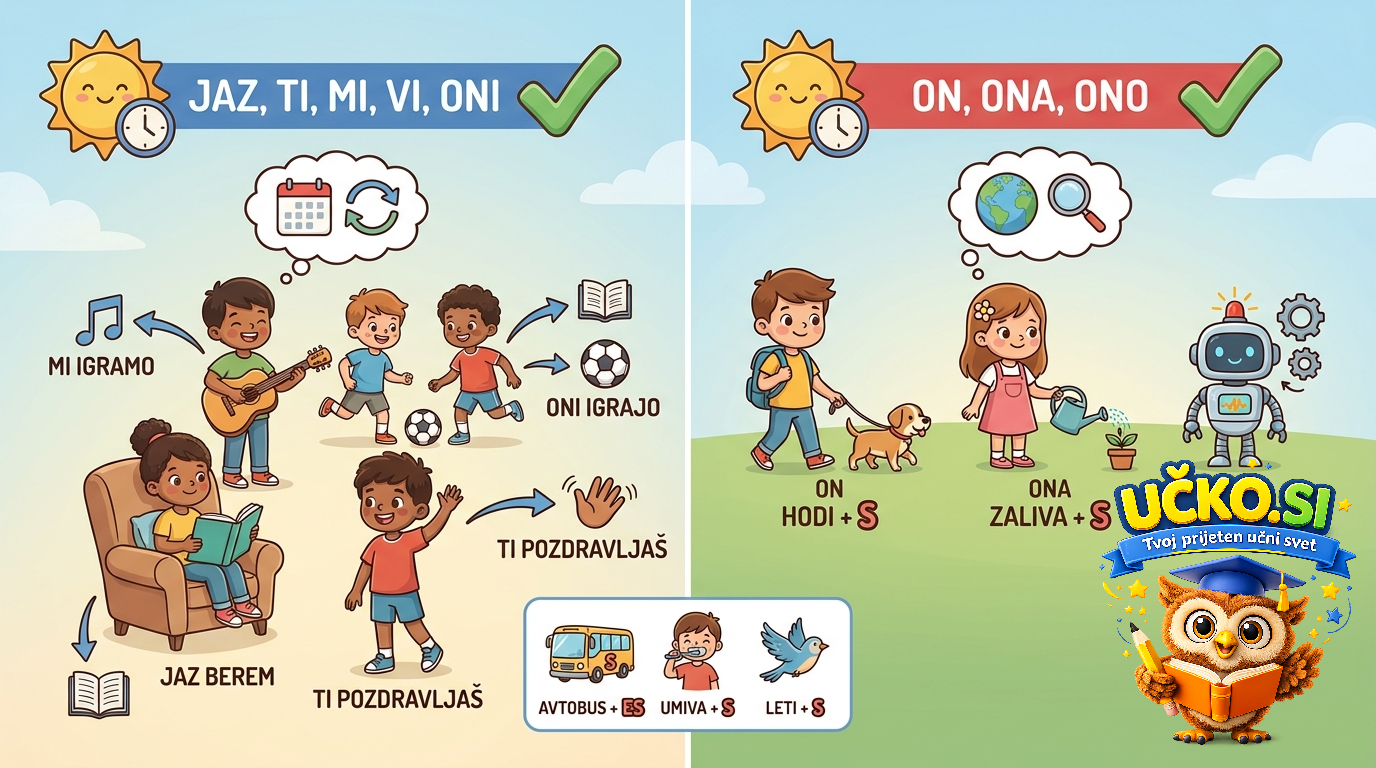
Grammar Rules: I, You, We, They
For subjects like I, You, We, They, or plural nouns (e.g., 'students'), we use the base form of the verb. The base form is the verb without 'to'. For example, 'I walk' or 'We play'.
- Use base form of the verb.
- Applies to I, You, We, They and plural nouns.
Grammar Rules: He, She, It
For subjects like He, She, It, or singular nouns (e.g., 'my friend'), we add -s or -es to the end of the verb. Most verbs just add -s, like 'He walks'. We add -es to verbs ending with -s, -sh, -ch, -x, -z, or -o, like 'She watches'.
- Add -s or -es to the verb.
- Applies to He, She, It and singular nouns.
- Add -es for verbs ending in -s, -sh, -ch, -x, -z, or -o.
Special Cases for -s/-es
If a verb ends in a consonant + 'y', we change 'y' to 'i' and add -es, for example, 'study' becomes 'studies'. However, if a verb ends in a vowel + 'y', we just add -s, like 'play' becomes 'plays'. Adverbs like 'always' or 'often' are used with the Present Simple.
- Consonant + y: change 'y' to 'i' and add -es.
- Vowel + y: just add -s.
- Adverbs of frequency are often used.
Zanimivosti
- The sun rises in the east.
- Birds fly.
Povzetek
The Present Simple affirmative form describes regular actions, facts, and habits. For I, You, We, They, use the base verb. For He, She, It, add -s or -es to the verb, with special rules for 'y' endings.
Pogosta vprašanja
Kaj se naučimo pri temi present simple – affirmative form?
Hello, future English speakers! Today we learn about the Present Simple. We use it to talk about things that are always true, happen regularly, or are facts. We will focus on making positive sentences, called the affirmative form.
Kaj je affirmative?
Meaning 'yes' or positive sentences.
Kaj je base form?
The verb without 'to' (e.g., walk, play).
Kaj je adverbs of frequency?
Words like 'always,' 'often,' 'usually' that show how often something happens.
Kako na kratko povzamemo temo present simple – affirmative form?
The Present Simple affirmative form describes regular actions, facts, and habits. For I, You, We, They, use the base verb. For He, She, It, add -s or -es to the verb, with special rules for 'y' endings.
Kje najdem vaje in vprašanja za temo present simple – affirmative form?
Za temo present simple – affirmative form (Angleščina, 6. razred) so v aplikaciji Učko.si kviz z vprašanji in odgovori ter vaje za preverjanje znanja.
Sorodne razlage – Angleščina, 6. razred
- present simple – negative form
- present simple – wh questions
- present simple – yes/no questions
- questions and short answers with have got
- questions and short answers with the verb be
- rooms in a home and household furniture
- some, any and a lot of
- superlative adjectives
- technology related vocabulary
- telling the time and expressing the hour
- the articles a and an
- the classroom environment and school equipment