present simple – negative form
Angleščina · 6. razred
Hello, Grade 6 English learners! Today we will learn how to make sentences negative in the Present Simple tense. This helps us say what someone DOES NOT do or what IS NOT true.
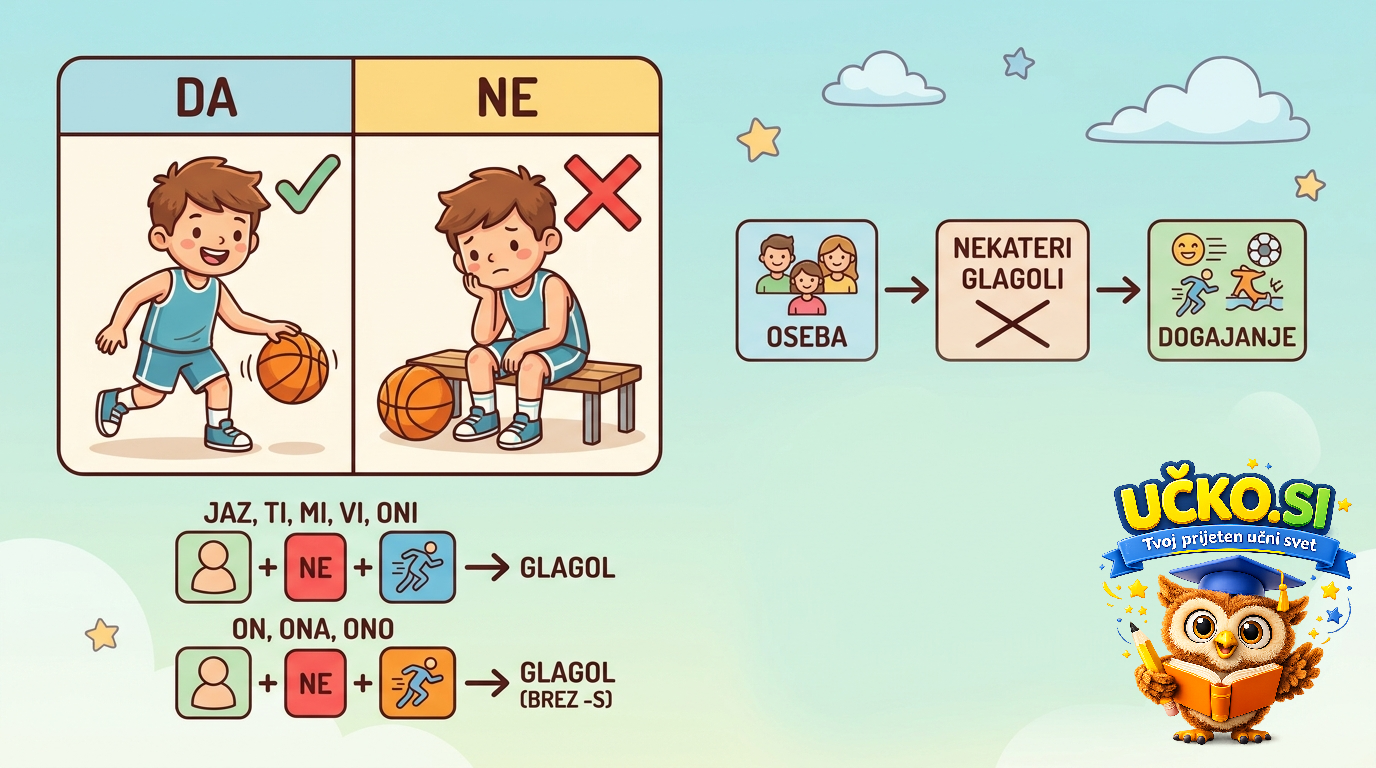
Ključni pojmi
- Do not / Don't
- Used to make sentences negative for I, YOU, WE, THEY, and plural subjects.
- Does not / Doesn't
- Used to make sentences negative for HE, SHE, IT, and singular subjects.
- Base form of the verb
- The simplest form of a verb, without any endings like -s, -es, -ing, or -ed.
- Subject
- The person or thing that performs the action in a sentence.
Using 'do not' or 'don't'
We use 'do not' or 'don't' with I, YOU, WE, THEY, and plural nouns. The structure is: Subject + do not (don't) + base form of the verb. For example, 'I don't like apples' and 'They don't speak French.' The verb always stays in its basic form.
- Use with I, YOU, WE, THEY, plural nouns.
- Structure: Subject + do not (don't) + base verb.
- Verb is always in base form (no -s or -es).
Using 'does not' or 'doesn't'
We use 'does not' or 'doesn't' with HE, SHE, IT, and singular nouns. The structure is: Subject + does not (doesn't) + base form of the verb. For instance, 'He doesn't eat meat' and 'She doesn't go to school.' The main verb also stays in its base form because 'does' already has the -s.
- Use with HE, SHE, IT, singular nouns.
- Structure: Subject + does not (doesn't) + base verb.
- Main verb stays in base form; no -s or -es.
Common Mistakes to Avoid
Remember not to add -s to the verb after 'doesn't.' For example, say 'He doesn't like pizza,' not 'He doesn't likes pizza.' Also, always use 'do not' or 'does not' for negatives; don't just say 'I not like apples.'
- Do not add -s to the verb after 'doesn't'.
- Always use 'do not' or 'does not' for negative sentences.
Zanimivosti
- The words 'do not' and 'does not' are often shortened to 'don't' and 'doesn't'.
- When using 'does not' or 'doesn't', the main verb does not add -s or -es because the -s is already in 'does'.
Povzetek
To make sentences negative in the Present Simple, we use 'do not' or 'does not'. 'Don't' is for I, YOU, WE, THEY, and plural nouns, while 'doesn't' is for HE, SHE, IT, and singular nouns. The main verb always remains in its base form.
Pogosta vprašanja
Kaj se naučimo pri temi present simple – negative form?
Hello, Grade 6 English learners! Today we will learn how to make sentences negative in the Present Simple tense. This helps us say what someone DOES NOT do or what IS NOT true.
Kaj je do not / don't?
Used to make sentences negative for I, YOU, WE, THEY, and plural subjects.
Kaj je does not / doesn't?
Used to make sentences negative for HE, SHE, IT, and singular subjects.
Kaj je base form of the verb?
The simplest form of a verb, without any endings like -s, -es, -ing, or -ed.
Kako na kratko povzamemo temo present simple – negative form?
To make sentences negative in the Present Simple, we use 'do not' or 'does not'. 'Don't' is for I, YOU, WE, THEY, and plural nouns, while 'doesn't' is for HE, SHE, IT, and singular nouns. The main verb always remains in its base form.
Sorodne razlage – Angleščina, 6. razred
- present simple – wh questions
- present simple – yes/no questions
- questions and short answers with have got
- questions and short answers with the verb be
- rooms in a home and household furniture
- some, any and a lot of
- superlative adjectives
- technology related vocabulary
- telling the time and expressing the hour
- the articles a and an
- the classroom environment and school equipment
- the english alphabet