Comparative adjectives
Angleščina · 9. razred
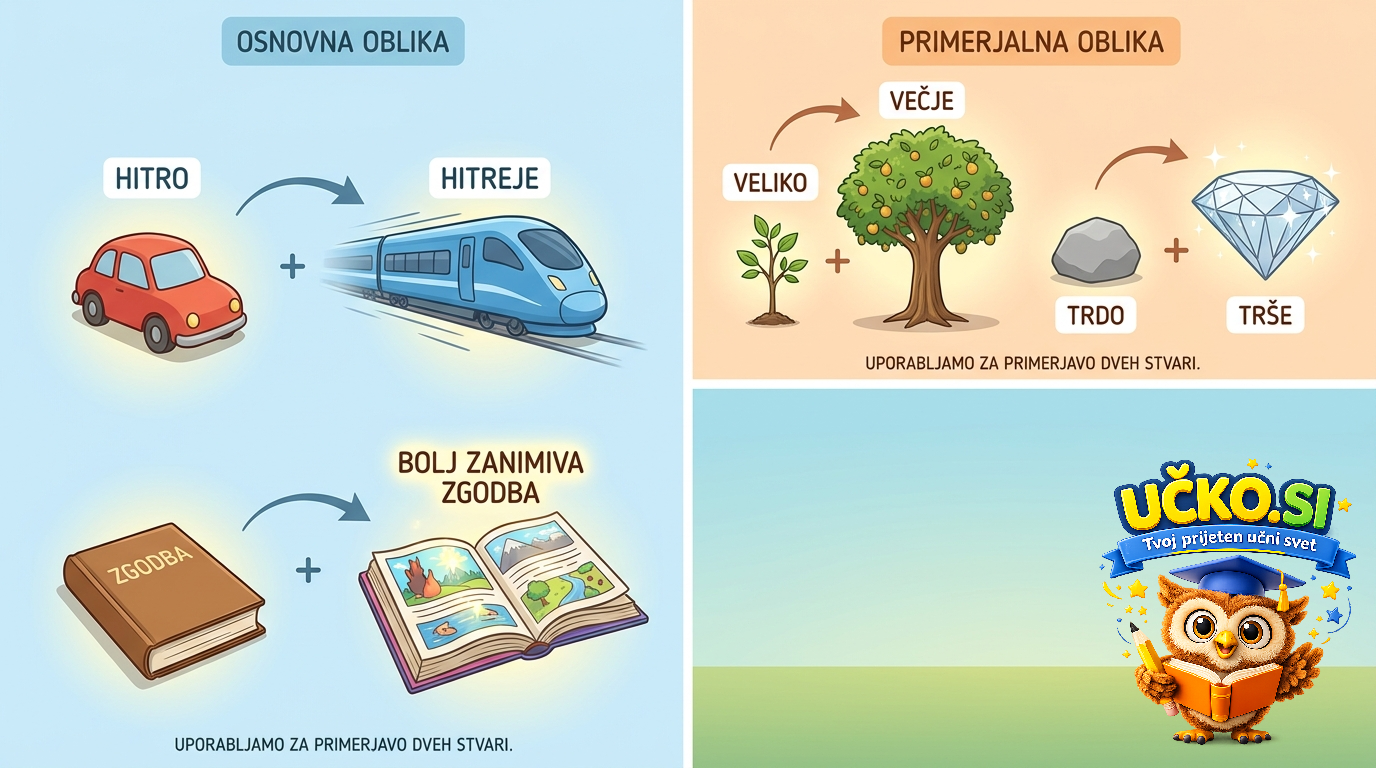
Comparative adjectives help us compare two things. They tell us that one thing has more of a certain quality than another. We use them to show differences between two nouns.
Ključni pojmi
- adjective
- A word that describes a noun.
- syllable
- A unit of pronunciation.
- irregular
- Not following the usual rules.
- compare
- To examine two or more things to find differences.
Forming Comparatives: Short Adjectives
For most one or two-syllable adjectives, we add '-er' to the end, like 'tall' becomes 'taller'. If an adjective ends in a consonant + vowel + consonant, we double the last consonant before adding '-er', for example, 'big' becomes 'bigger'. Adjectives ending in '-y' change to '-i' before adding '-er', so 'happy' becomes 'happier'.
- Add '-er' for most short adjectives.
- Double the last consonant for CVC endings.
- Change '-y' to '-i' before adding '-er'.
Forming Comparatives: Long Adjectives
For adjectives with three or more syllables, we don't add '-er'. Instead, we place the word 'more' in front of the adjective. For example, 'beautiful' becomes 'more beautiful'. This rule applies to words like 'expensive' and 'difficult' too, making them 'more expensive' and 'more difficult'.
- Use 'more' before adjectives with three or more syllables.
- Do not add '-er' to long adjectives.
Using 'than' and Irregular Comparatives
When comparing two things, we usually put the word 'than' after the comparative adjective. For instance, 'My dog is bigger than your cat.' Some adjectives have irregular comparative forms that must be learned, like 'good' becoming 'better' and 'bad' becoming 'worse'. Other irregular examples include 'far' to 'farther/further' and 'little' to 'less'.
- Use 'than' after the comparative adjective.
- Memorize irregular comparative forms.
- Irregular examples: good/better, bad/worse, far/farther.
Zanimivosti
- We use comparative adjectives to compare exactly two things.
- The word 'than' means 'kot' in Slovenian.
Povzetek
Comparative adjectives are used to compare two things, showing which has more of a quality. We form them by adding '-er' to short adjectives or using 'more' before long adjectives. Remember to use 'than' in comparisons and learn the irregular forms.
Pogosta vprašanja
Kaj se naučimo pri temi Comparative adjectives?
Comparative adjectives help us compare two things. They tell us that one thing has more of a certain quality than another. We use them to show differences between two nouns.
Kaj je adjective?
A word that describes a noun.
Kaj je syllable?
A unit of pronunciation.
Kaj je irregular?
Not following the usual rules.
Kako na kratko povzamemo temo Comparative adjectives?
Comparative adjectives are used to compare two things, showing which has more of a quality. We form them by adding '-er' to short adjectives or using 'more' before long adjectives. Remember to use 'than' in comparisons and learn the irregular forms.
Kje najdem vaje in vprašanja za temo Comparative adjectives?
Za temo Comparative adjectives (Angleščina, 9. razred) so v aplikaciji Učko.si kviz z vprašanji in odgovori ter vaje za preverjanje znanja.
Sorodne razlage – Angleščina, 9. razred
- Comparing ideas and perspectives
- Conditional sentences
- Defining relative clauses
- Describing people
- Describing personality
- Diphthongs
- First conditional
- Following a conversation
- Future continuous
- Future forms
- Future tenses: review
- Gerund and infinitive