The English and the Slovenes: how we are alike and different
Angleščina · 7. razred
Slovenia and England are both European countries with unique traditions and habits. By comparing them, we can learn more about our own culture and improve our English skills. Even though we live far apart, we share many interests.
Ključni pojmi
- Countryside
- The green land and areas outside of towns and cities.
- Polite
- Having good manners and being respectful to other people.
- Direct
- Saying exactly what you think in a clear and honest way.
- Whereas
- A word used to compare or show a difference between two things.
- Habit
- Something that a person or a nation does often or regularly.
Daily Life and Hobbies
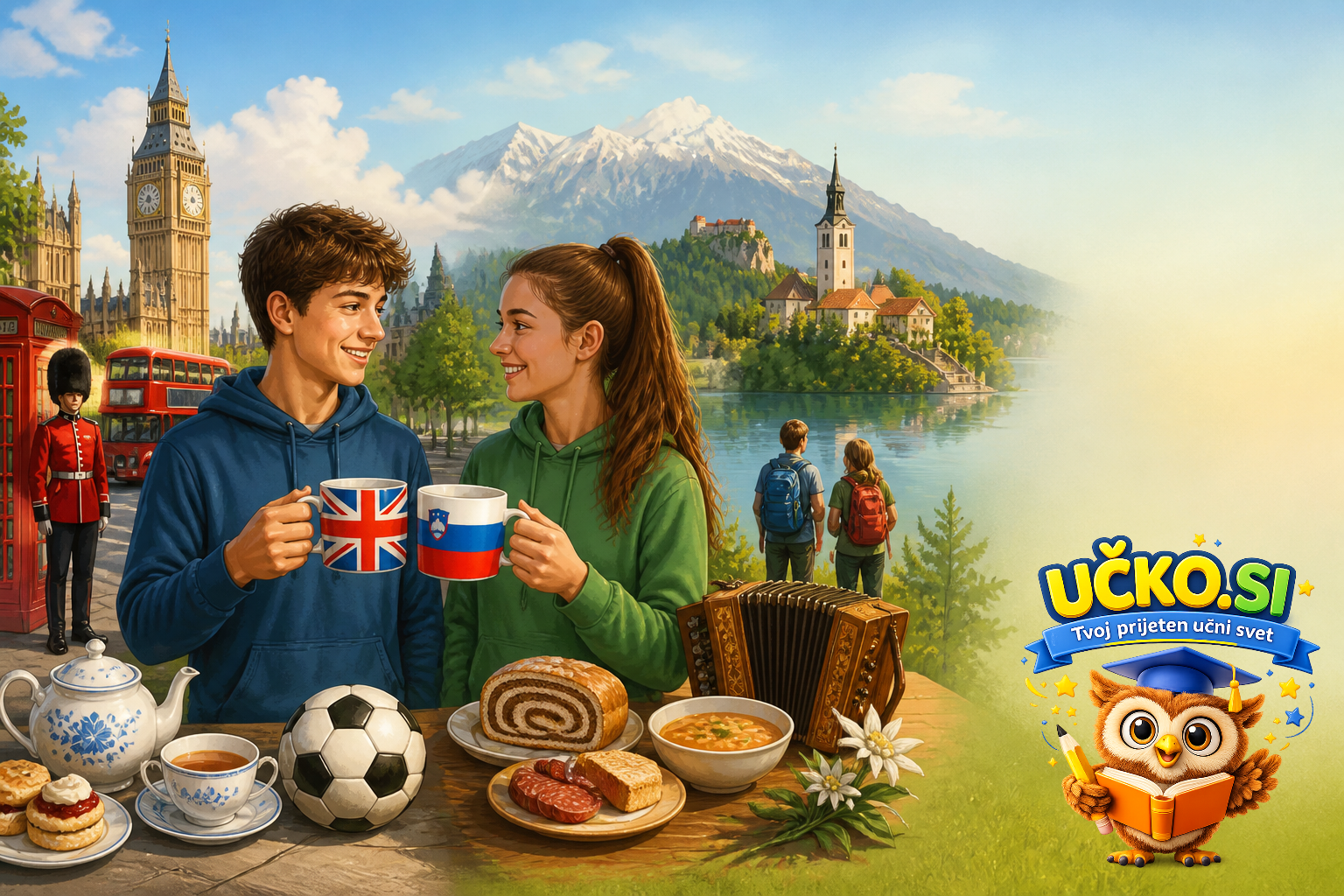
Both nations love nature and spending time outdoors. Slovenes are famous for hiking in the Alps, while English people enjoy gardening and walking in the green countryside. Football is the most popular sport in both countries. However, food habits are different because English people often drink tea with milk while Slovenes prefer black coffee.
- Both nations share a love for nature and football
- Slovenes prefer hiking, while English people enjoy gardening
- English people drink tea with milk, but Slovenes usually prefer black coffee
Politeness and Character
English people are known for being very polite and using words like 'sorry' and 'thank you' often. Slovenes are usually more direct and say exactly what they think. In England, people use 'small talk' about the weather to start a conversation. In Slovenia, people usually talk about work or family when they meet friends.
- English people are very polite and use frequent polite words
- Slovenes are more direct in their communication style
- Small talk about the weather is a common English habit
Comparing Two Nations
We use comparative adjectives to talk about differences between the two countries. For short words, we add '-er', and for long words, we use 'more' before the adjective. We use the word 'than' to connect the things we are comparing. We also use 'both' for similarities and 'unlike' for differences.
- Add '-er' to short adjectives and 'more' to long adjectives
- Use 'than' to connect two things being compared
- Use 'both' for similarities and 'unlike' for differences
Zanimivosti
- In England, people often talk about the weather to start a conversation, which is called small talk.
- Unlike Slovenes, English people drive on the left side of the road.
- English people are very careful about waiting in queues.
Povzetek
Slovenia and England share a love for nature and football but have different habits regarding food and conversation. By using comparative adjectives, we can easily describe how these two cultures are alike and different.
Pogosta vprašanja
Kaj se naučimo pri temi The English and the Slovenes: how we are alike and different?
Slovenia and England are both European countries with unique traditions and habits. By comparing them, we can learn more about our own culture and improve our English skills. Even though we live far apart, we share many interests.
Kaj je countryside?
The green land and areas outside of towns and cities.
Kaj je polite?
Having good manners and being respectful to other people.
Kaj je direct?
Saying exactly what you think in a clear and honest way.
Kako na kratko povzamemo temo The English and the Slovenes: how we are alike and different?
Slovenia and England share a love for nature and football but have different habits regarding food and conversation. By using comparative adjectives, we can easily describe how these two cultures are alike and different.
Sorodne razlage – Angleščina, 7. razred
- The imperative: orders and instructions
- The possessive case: whose is it?
- THE REAL ME AND MY DREAMS
- The suitcase is packed: going abroad
- The verb can: all the things I can do
- The verb have to: what needs to be done
- The verb must: things I have to do
- The verb should: a piece of good advice
- The verbs be and have got in action
- There is / there are: what is where
- Things I like and things I don't
- This/these — that/those: near and far