Active and passive
Angleščina · 9. razred
Today, we're learning about Active and Passive Voice. This helps us understand if the subject of a sentence is doing or receiving an action. Mastering this will make your English sound more natural and varied.
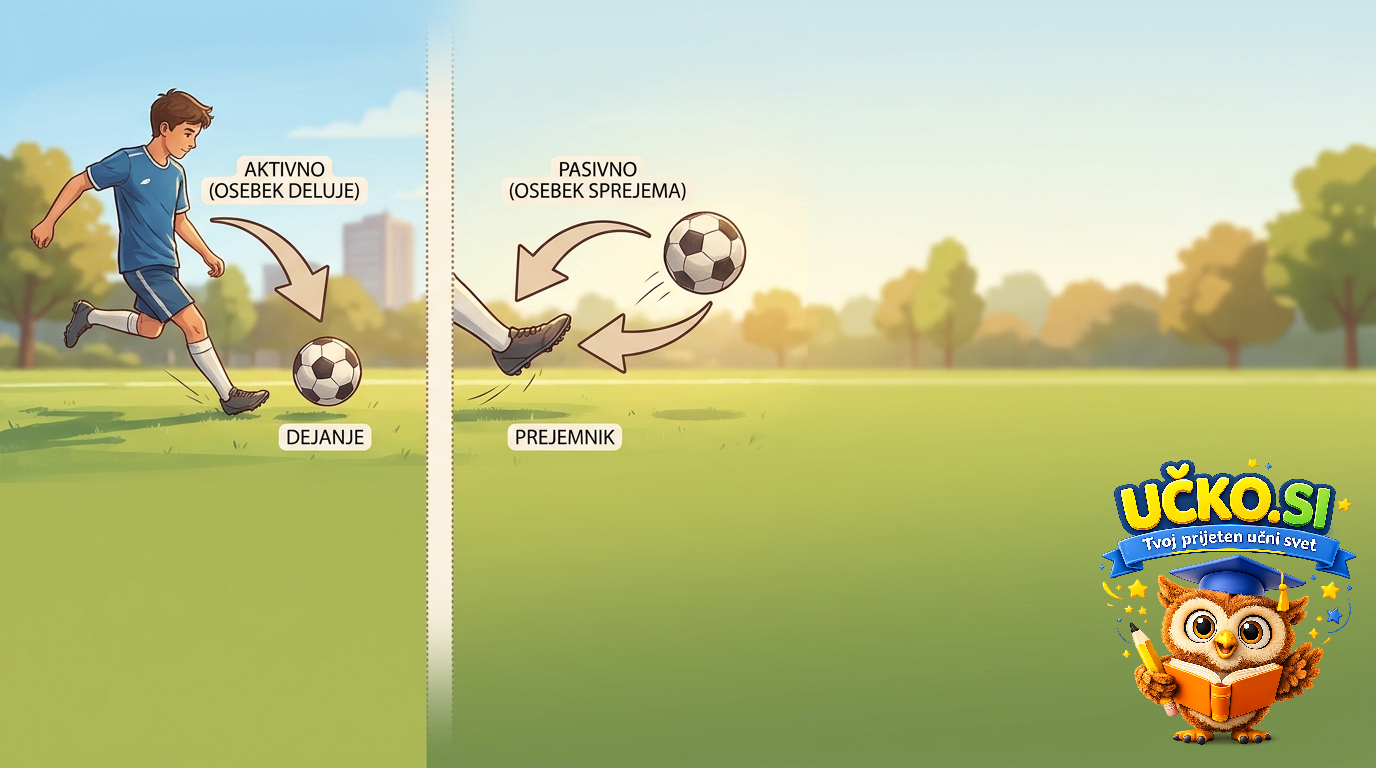
Ključni pojmi
- Active Voice
- The subject of the sentence performs the action.
- Passive Voice
- The subject of the sentence receives the action.
- Subject
- The person or thing performing or receiving the action.
- Past Participle
- The third form of the verb, used in passive voice.
- Agent/Doer
- The person or thing performing the action, often introduced by 'by' in passive voice.
Active Voice
In active voice, the subject performs the action. This is the most common way we speak and write because it's direct, clear, and usually shorter. The structure is Subject + Verb + Object. For example, 'The dog chased the cat,' where 'the dog' is doing the chasing.
- Subject performs the action.
- Structure: Subject + Verb + Object.
- Clearer and more direct.
Passive Voice
In passive voice, the subject receives the action; the action is done TO the subject. We often use it when the doer is unknown or unimportant, or when the action itself is more important. The structure is Subject + 'to be' verb + Past Participle. For instance, 'The cat was chased by the dog,' showing the cat received the action.
- Subject receives the action.
- Structure: Subject + 'to be' verb + Past Participle.
- Used when the doer is unknown or unimportant.
When to Use Passive Voice
Passive voice is useful when the doer of the action is unknown or less important, like in 'My wallet was stolen.' It also emphasizes the action or object, as in 'America was discovered in 1492.' You'll often see it in formal writing, scientific reports, or news reports, for example, 'The experiment was conducted successfully.'
- Use when the doer is unknown or unimportant.
- Use to emphasize the action or object.
- Common in formal writing and reports.
Zanimivosti
- The 'doer' in passive voice is often less important, unknown, or not mentioned at all.
- The main verb in passive voice is always in its past participle form.
- The 'to be' verb in passive voice changes according to the tense of the original active sentence.
Povzetek
Active voice means the subject does the action, making sentences clear and direct. Passive voice means the subject receives the action, useful when the doer is unknown or the action is more important. Understanding both helps you communicate more effectively in English.
Pogosta vprašanja
Kaj se naučimo pri temi Active and passive?
Today, we're learning about Active and Passive Voice. This helps us understand if the subject of a sentence is doing or receiving an action. Mastering this will make your English sound more natural and varied.
Kaj je active voice?
The subject of the sentence performs the action.
Kaj je passive voice?
The subject of the sentence receives the action.
Kaj je subject?
The person or thing performing or receiving the action.
Kako na kratko povzamemo temo Active and passive?
Active voice means the subject does the action, making sentences clear and direct. Passive voice means the subject receives the action, useful when the doer is unknown or the action is more important. Understanding both helps you communicate more effectively in English.
Sorodne razlage – Angleščina, 9. razred
- Active and passive voice
- Adjectives and descriptive language
- Advice and obligation
- An informal email
- An online post
- An opinion essay
- Art and photography
- Asking for and giving information
- Buying tickets
- Checking information
- Comparative adjectives
- Comparing ideas and perspectives