daily tasks and routines
Angleščina · 8. razred
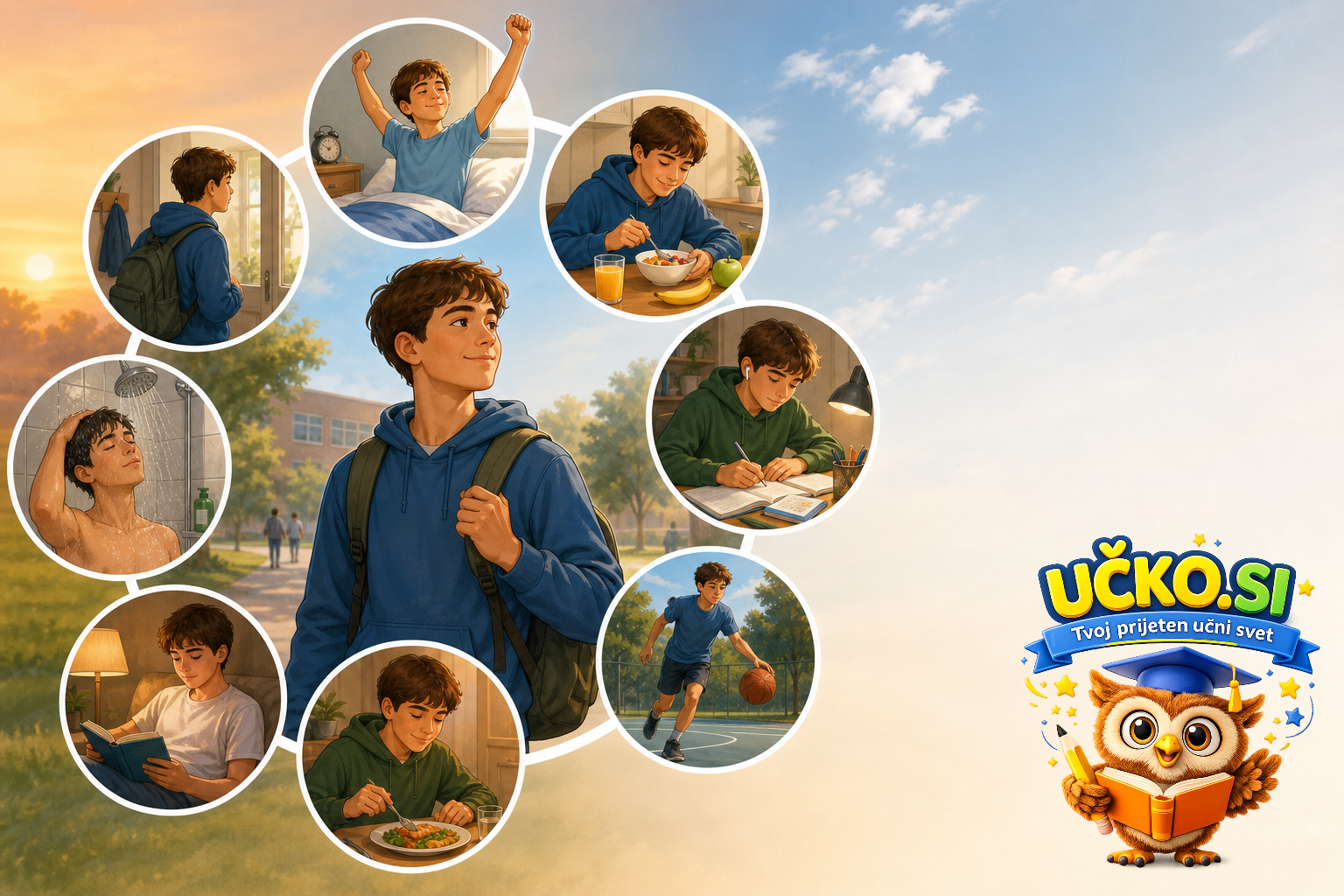
Hello, Grade 8 students! Today we will learn about 'Daily Tasks and Routines' in English. This means talking about the things you do every day, morning, afternoon, and evening.
Ključni pojmi
- Wake up
- To stop sleeping.
- Simple Present Tense
- Used for habits and routines.
- Adverbs of Frequency
- Words showing how often something happens.
- Do homework
- To complete school assignments.
- Go to bed
- To go to sleep at night.
Key Vocabulary
Learning new words helps you describe your day. Some important words include 'wake up', 'get dressed', 'have breakfast', 'go to school', 'do homework', and 'go to bed'. You also learn phrases like 'brush my teeth' and 'wash my face'.
- Words like 'wake up' and 'get up' describe morning actions.
- 'Have breakfast', 'have lunch', and 'have dinner' are mealtime phrases.
Simple Present Tense
We use the Simple Present Tense to talk about habits and routines. For 'I, you, we, they', use the base form of the verb, like 'I eat'. For 'he, she, it', add -s or -es, such as 'He eats' or 'She goes'.
- Use base verb for I, you, we, they (e.g., 'I go').
- Add -s or -es for he, she, it (e.g., 'She goes').
Adverbs of Frequency
Adverbs of frequency tell us how often something happens. They usually come before the main verb. Examples include 'always', 'usually', 'often', 'sometimes', 'hardly ever', and 'never'.
- Adverbs of frequency show how often an action occurs.
- They typically go before the main verb (e.g., 'I always eat').
Describing Your Day
You can describe your day by listing your activities from morning to evening. For example, 'I wake up at 6:30 AM' or 'After school, I do my homework'. This helps you practice using the new vocabulary and grammar.
- Start with morning activities (e.g., 'wake up', 'get dressed').
- Continue with afternoon and evening tasks (e.g., 'do homework', 'have dinner').
Zanimivosti
- Most verbs add -s for he, she, it in Simple Present Tense (e.g., 'play' -> 'plays').
- Verbs ending in consonant + y change y to i and add -es (e.g., 'study' -> 'studies').
Povzetek
This lesson introduced vocabulary for daily tasks and routines. We learned to use the Simple Present Tense and adverbs of frequency to describe everyday activities. Practicing these will help you talk about your day in English.
Pogosta vprašanja
Kaj se naučimo pri temi daily tasks and routines?
Hello, Grade 8 students! Today we will learn about 'Daily Tasks and Routines' in English. This means talking about the things you do every day, morning, afternoon, and evening.
Kaj je wake up?
To stop sleeping.
Kaj je simple present tense?
Used for habits and routines.
Kaj je adverbs of frequency?
Words showing how often something happens.
Kako na kratko povzamemo temo daily tasks and routines?
This lesson introduced vocabulary for daily tasks and routines. We learned to use the Simple Present Tense and adverbs of frequency to describe everyday activities. Practicing these will help you talk about your day in English.
Sorodne razlage – Angleščina, 8. razred
- describing processes and situations
- developing communication skills
- dreams, relationships and personal goals
- environmental awareness and community actions
- everyday shopping and consumer choices
- family life and hobbies
- fashion and personal expression
- food and restaurant situations
- formal and informal communication
- friendships and social relationships
- giving opinions and arguments
- helping at home and independence