What will the weather be like? The weather forecast
Angleščina · 7. razred
This lesson helps you learn how to describe the weather and understand future forecasts. You will discover how to turn weather nouns into adjectives and use the future tense correctly.
Ključni pojmi
- Weather forecast
- A prediction of what the weather will be like in the future.
- Degrees Celsius
- The units used to measure how hot or cold the temperature is.
- Won't
- The short form of 'will not,' used for negative predictions.
- Thunderstorm
- A heavy storm that includes lightning.
- Umbrella
- An object you use to stay dry when it is pouring with rain.
Weather Vocabulary and Temperature
To describe the weather, we often add the letter -y to a noun, turning 'sun' into 'sunny' or 'cloud' into 'cloudy.' Temperature is measured in degrees Celsius to describe if it is hot, warm, cool, cold, or freezing. Other useful phrases include a light breeze, showers, or a thunderstorm. If it is raining very hard, we say it is pouring with rain.
- Add -y to nouns like rain, snow, and wind to make adjectives.
- Use degrees Celsius to measure how hot or cold it is.
- Words like 'foggy' and 'stormy' describe specific weather conditions.
Using Will for Future Predictions
We use 'will' to talk about the future weather because it is a prediction, not a certain plan. In affirmative sentences, use 'will' plus a verb, such as 'It will be sunny.' For negative sentences, use 'won't,' like 'It won't rain tomorrow.' To ask a question, start with 'Will,' for example, 'Will it be windy?'
- Use 'will' for predictions that are not 100 percent certain.
- Use 'won't' as the negative form of 'will not.'
- Ask 'What will the weather be like?' to find out about the future.
Reading a Weather Forecast
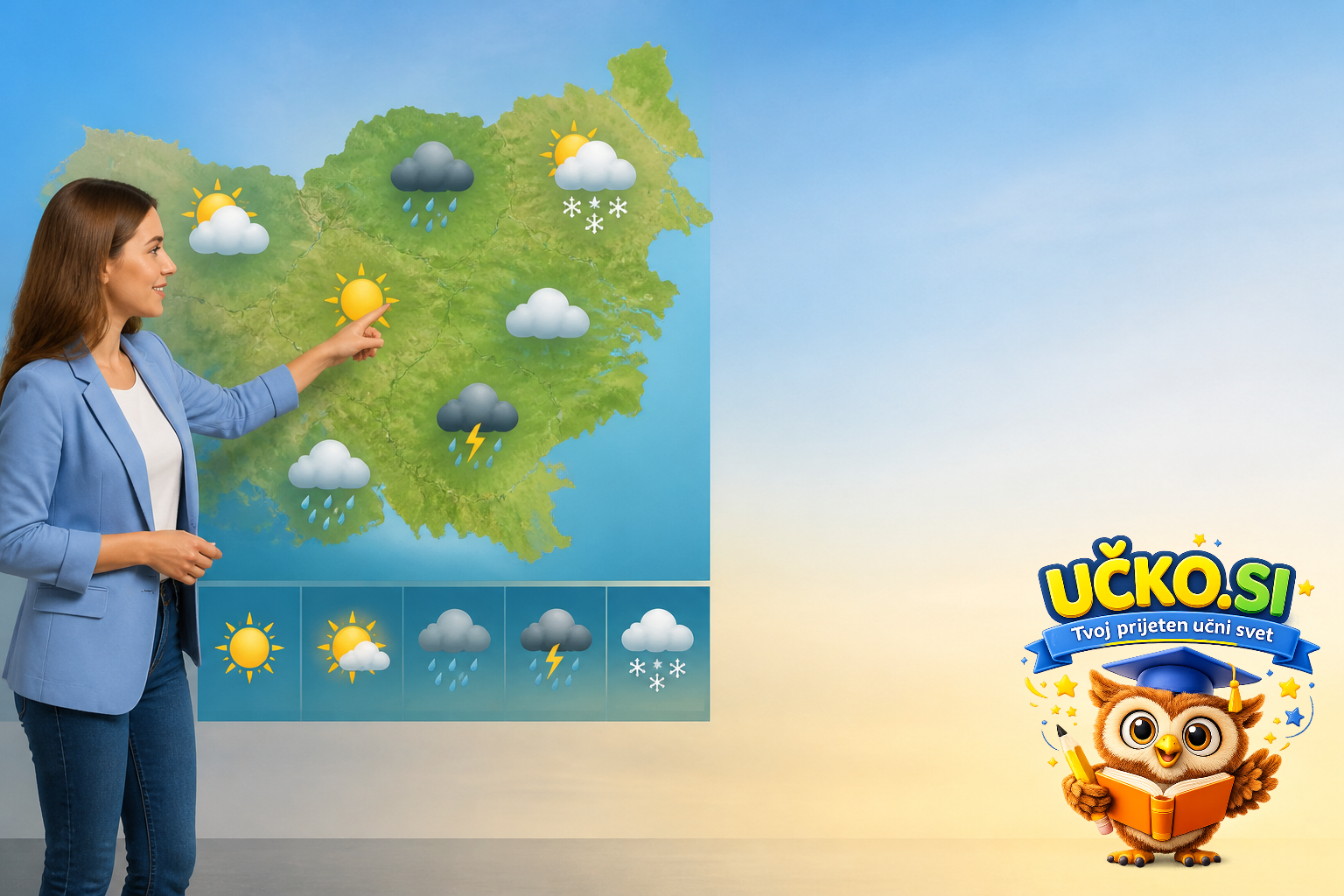
A weather forecast tells us what to expect, like fog in the valleys or a clear sky. It might mention a maximum temperature or warn you about heavy rain in specific areas. If the forecast says it will be stormy, don't forget to take your umbrella. Temperatures can drop quickly, making the air feel quite cool.
- Forecasts provide the maximum temperature for the day.
- Common forecast terms include 'clear sky' and 'heavy rain.'
- Weather can change quickly from a sunny morning to a windy afternoon.
Zanimivosti
- You can turn many weather nouns into adjectives just by adding the letter -y.
- Weather is described with 'will' because forecasts are predictions, not 100 percent certain plans.
Povzetek
To talk about the weather, use adjectives like rainy or windy and 'will' for future predictions. Understanding these words and grammar rules helps you read a weather forecast and prepare for the day.
Pogosta vprašanja
Kaj se naučimo pri temi What will the weather be like? The weather forecast?
This lesson helps you learn how to describe the weather and understand future forecasts. You will discover how to turn weather nouns into adjectives and use the future tense correctly.
Kaj je weather forecast?
A prediction of what the weather will be like in the future.
Kaj je degrees celsius?
The units used to measure how hot or cold the temperature is.
Kaj je won't?
The short form of 'will not,' used for negative predictions.
Kako na kratko povzamemo temo What will the weather be like? The weather forecast?
To talk about the weather, use adjectives like rainy or windy and 'will' for future predictions. Understanding these words and grammar rules helps you read a weather forecast and prepare for the day.
Sorodne razlage – Angleščina, 7. razred
- Why do the English drink afternoon tea?
- Writing my personal diary
- A school day here and in England
- A trip around the British Isles: Great Britain and Ireland
- A visit to the zoo
- Articles: a/an or the?
- At the airport and on the plane
- AT THE TABLE
- Comparison of adjectives: bigger, the biggest
- Counting to 100
- Do I eat healthily?
- DO YOU REMEMBER?