the verb be – negative form
Angleščina · 6. razred
Hello, future English speakers! Today we will learn how to make sentences negative using the verb 'to be'. This helps us say things like 'I am not happy' or 'They are not sad'.
Ključni pojmi
- to be
- A verb that tells us who or what something is.
- negative form
- Used to say that something is not true.
- contraction
- A short form of two words, like 'isn't'.
Making 'To Be' Negative
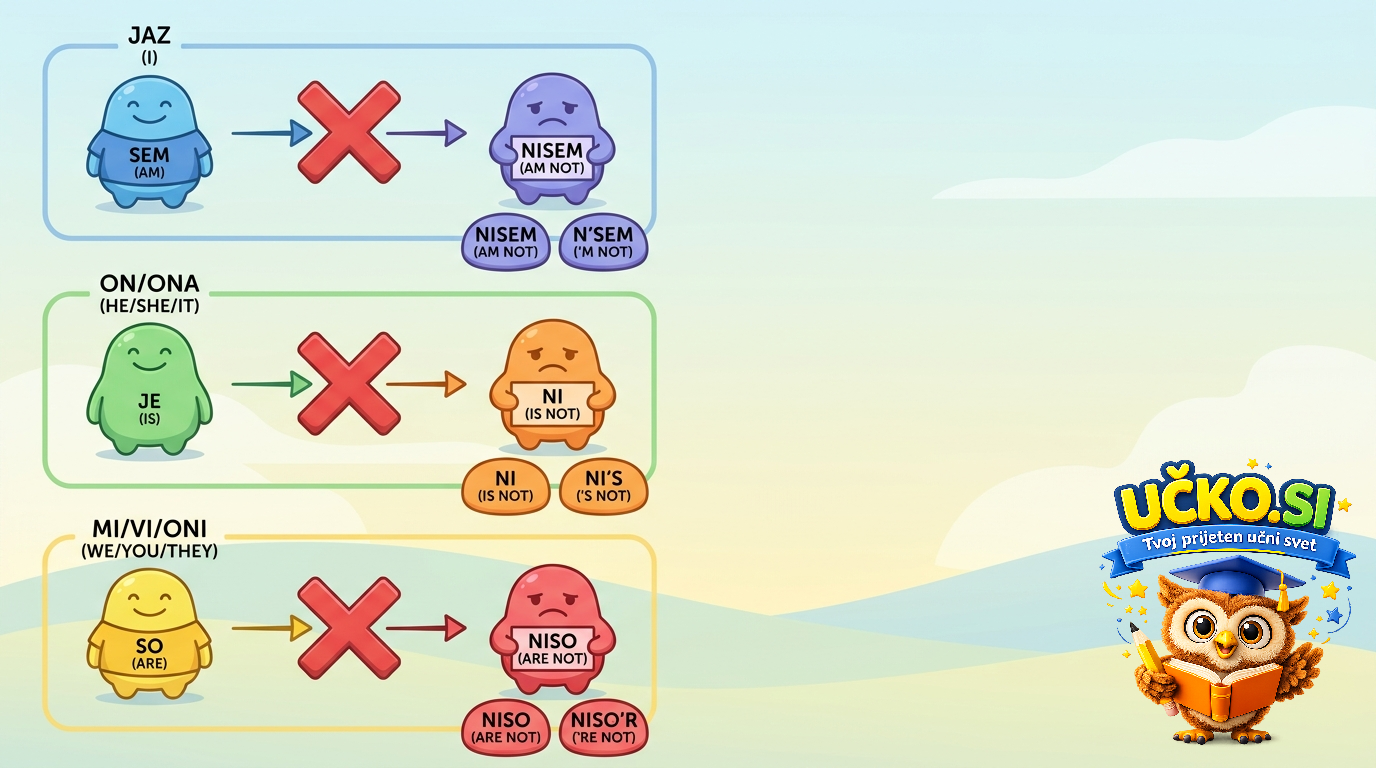
The verb 'to be' tells us what something is or how someone feels. To make it negative, simply add the word 'not' after 'am', 'is', or 'are'. For example, 'I am happy' becomes 'I am not happy'.
- Add 'not' after 'am', 'is', or 'are'.
- Rule: Subject + am/is/are + not + rest of the sentence.
Using Contractions
Contractions are short forms that make English sound more natural. For 'is not', we use 'isn't', like 'He isn't sad'. For 'are not', we use 'aren't', like 'We aren't ready'.
- 'is not' becomes 'isn't'.
- 'are not' becomes 'aren't'.
- We usually DO NOT use a contraction for 'am not'.
Zanimivosti
- The verb 'to be' is one of the most important verbs in English.
- Contractions make speaking and writing faster.
Povzetek
To make the verb 'to be' negative, add 'not' after 'am', 'is', or 'are'. We often use contractions like 'isn't' for 'is not' and 'aren't' for 'are not'.
Pogosta vprašanja
Kaj se naučimo pri temi the verb be – negative form?
Hello, future English speakers! Today we will learn how to make sentences negative using the verb 'to be'. This helps us say things like 'I am not happy' or 'They are not sad'.
Kaj je to be?
A verb that tells us who or what something is.
Kaj je negative form?
Used to say that something is not true.
Kaj je contraction?
A short form of two words, like 'isn't'.
Kako na kratko povzamemo temo the verb be – negative form?
To make the verb 'to be' negative, add 'not' after 'am', 'is', or 'are'. We often use contractions like 'isn't' for 'is not' and 'aren't' for 'are not'.
Sorodne razlage – Angleščina, 6. razred
- there is and there are
- verbs used to express likes and dislikes
- vocabulary related to buying food
- activities people do in their free time
- adjectives used to describe emotions and feelings
- adjectives used to describe places
- can and can't
- clothing and fashion accessories
- common classroom instructions
- common transport related word combinations
- comparative adjectives
- countable and uncountable nouns