have got – negative form
Angleščina · 6. razred
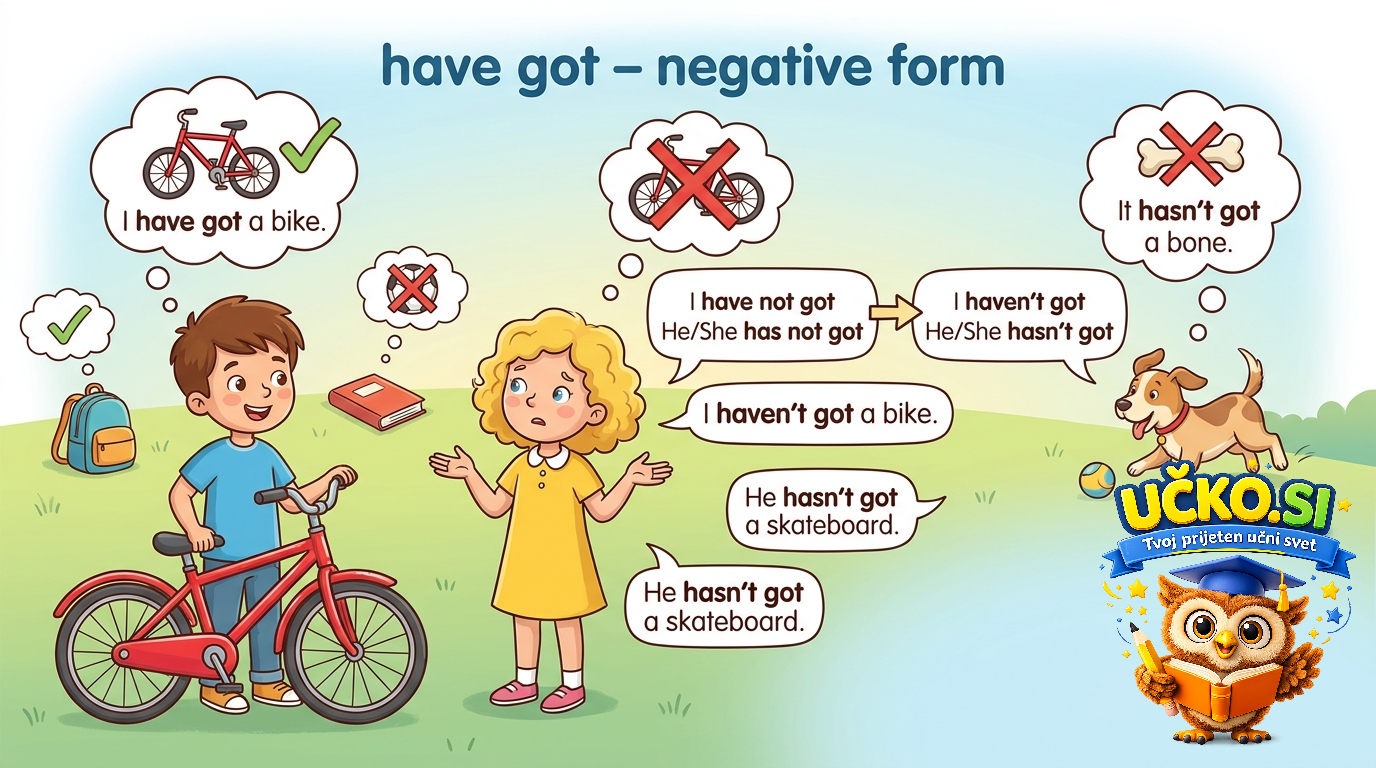
Today, we're learning how to say you *don't* have something using 'have got'. This is called the negative form. It's super useful for talking about things you don't possess.
Ključni pojmi
- Negative form
- To say you *don't* have something.
- Haven't got
- Short for 'have not got', used with I, you, we, they.
- Hasn't got
- Short for 'has not got', used with he, she, it.
- Subject
- The person or thing performing the action (e.g., I, she, the dog).
Making 'Have Got' Negative
To make 'have got' negative, we simply add 'NOT' after 'have' or 'has'. The basic rule is: SUBJECT + HAVE/HAS + NOT + GOT + OBJECT. This tells us that someone doesn't own or possess something. It's a very straightforward English rule.
- Add 'NOT' after 'have' or 'has'.
- The word 'got' always stays the same.
Using Haven't Got and Hasn't Got
For 'I, YOU, WE, THEY', we use 'HAVE NOT GOT', which is usually shortened to 'HAVEN'T GOT'. For 'HE, SHE, IT', we use 'HAS NOT GOT', shortened to 'HASN'T GOT'. Remember 'it' is for animals or things, so 'the dog' would use 'hasn't got'.
- I, YOU, WE, THEY use 'haven't got'.
- HE, SHE, IT use 'hasn't got'.
Examples and Important Tips
If you want to say 'I don't have a bike', you say 'I haven't got a bike'. If 'she doesn't have a sister', it's 'She hasn't got a sister'. Always check the subject to pick 'haven't' or 'hasn't'. The 'got' part never changes.
- Compare positive: 'I have got a bike' with negative: 'I haven't got a bike'.
- 'Haven't got' and 'hasn't got' are common in British English.
Zanimivosti
- The 'got' part does NOT change; it's always 'got'.
- We don't say 'haven't get' or 'hasn't get'.
Povzetek
To make 'have got' negative, we use 'haven't got' for I, you, we, they, and 'hasn't got' for he, she, it. Remember to always keep 'got' in the sentence. This helps us say what someone doesn't have.
Pogosta vprašanja
Kaj se naučimo pri temi have got – negative form?
Today, we're learning how to say you *don't* have something using 'have got'. This is called the negative form. It's super useful for talking about things you don't possess.
Kaj je negative form?
To say you *don't* have something.
Kaj je haven't got?
Short for 'have not got', used with I, you, we, they.
Kaj je hasn't got?
Short for 'has not got', used with he, she, it.
Kako na kratko povzamemo temo have got – negative form?
To make 'have got' negative, we use 'haven't got' for I, you, we, they, and 'hasn't got' for he, she, it. Remember to always keep 'got' in the sentence. This helps us say what someone doesn't have.
Sorodne razlage – Angleščina, 6. razred
- imperatives
- jobs and occupations
- means of transport
- names of colours
- names of countries and nationalities
- numbers from 1 to 100
- object pronouns
- parts of the body and face
- past simple – negative form
- past simple – questions
- past simple of irregular verbs – affirmative form
- past simple of regular verbs – affirmative form