My daily routine
Angleščina · 3. razred
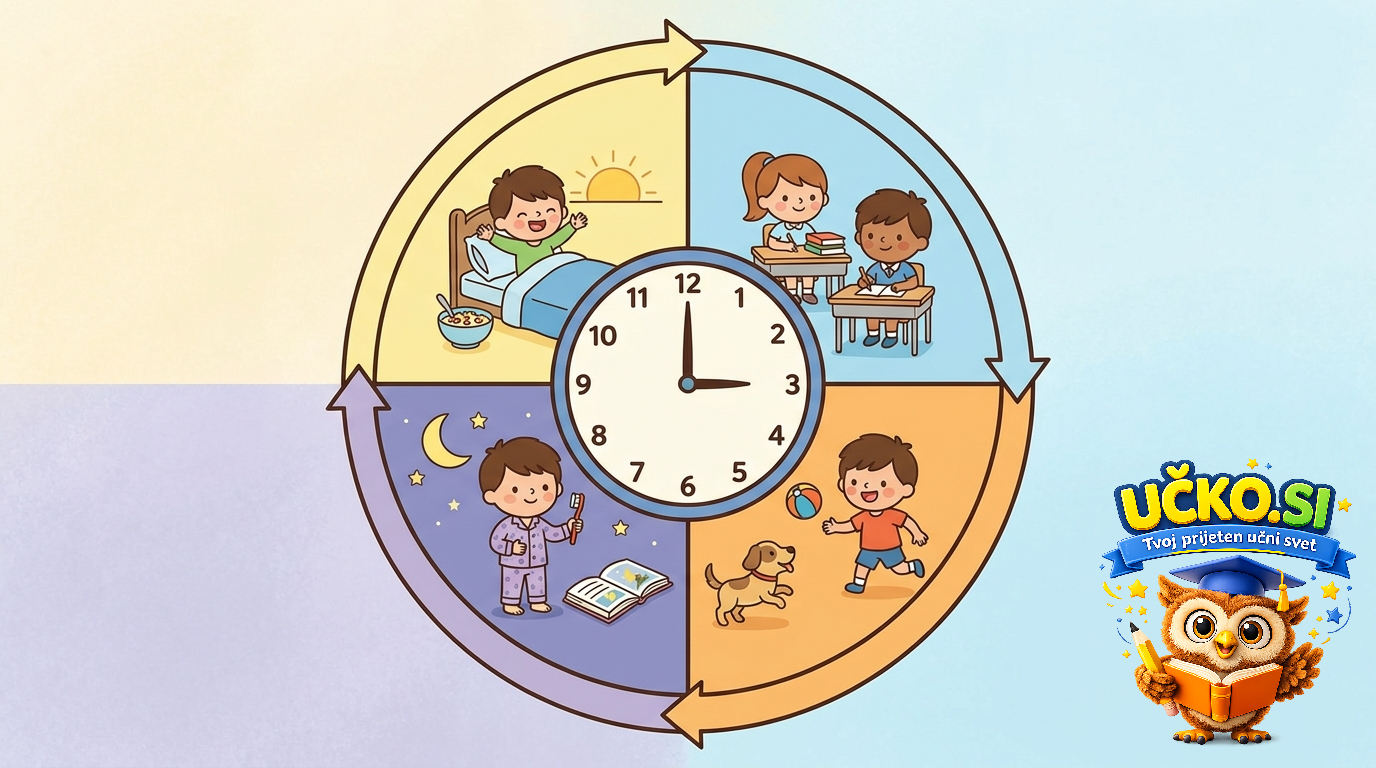
Hello, young learners! Today, we will learn about 'My Daily Routine'. This means what you do every day. It helps us talk about our lives in English.
Ključni pojmi
- Wake up
- When you open your eyes in the morning.
- Go to school
- When you go to school to learn.
- Have breakfast
- When you eat your first meal of the day.
- Simple Present Tense
- Used for things that happen regularly or every day.
Important Words for Your Day
We use special words to talk about our daily activities. For example, 'wake up' is when you open your eyes in the morning. 'Go to school' means you go to learn. 'Have breakfast' is your first meal of the day.
- Learn words like 'wake up,' 'brush my teeth,' and 'go to school.'
- These words help describe what you do every day.
Talking About What You Do (Simple Present Tense)
When we talk about things we do regularly, we use the Simple Present Tense. For 'I', 'You', 'We', 'They', the verb stays the same, like 'I eat breakfast'. For 'He', 'She', 'It', we add '-s' or '-es' to the verb, for example, 'She plays outside'.
- Use Simple Present Tense for daily actions.
- Add '-s' or '-es' to verbs for 'He', 'She', 'It'.
Saying When Things Happen
We use 'at' with specific times, like 'I wake up at 7 o'clock'. We also use 'in the morning', 'in the afternoon', 'in the evening', and 'at night'. For example, 'I have breakfast in the morning' and 'I do my homework in the afternoon'.
- Use 'at' for specific times.
- Use 'in the morning', 'in the afternoon', 'in the evening', and 'at night' for parts of the day.
Zanimivosti
- A daily routine is what you do every day.
- The Simple Present Tense is for things that happen regularly.
Povzetek
Learning about your daily routine helps you talk about your day in English. Remember to use the correct words and speak about when things happen. Keep practicing!
Pogosta vprašanja
Kaj se naučimo pri temi My daily routine?
Hello, young learners! Today, we will learn about 'My Daily Routine'. This means what you do every day. It helps us talk about our lives in English.
Kaj je wake up?
When you open your eyes in the morning.
Kaj je go to school?
When you go to school to learn.
Kaj je have breakfast?
When you eat your first meal of the day.
Kako na kratko povzamemo temo My daily routine?
Learning about your daily routine helps you talk about your day in English. Remember to use the correct words and speak about when things happen. Keep practicing!
Sorodne razlage – Angleščina, 3. razred
- My house and rooms
- Numbers to 100
- Parts of the body
- Pets
- Places in town
- School objects
- Short stories and simple dialogues
- Talking about yourself
- Weather and seasons
- Animals
- Asking and answering simple questions
- Classroom language